Articles | Volume 12, issue 1
https://doi.org/10.5194/ascmo-12-123-2026
© Author(s) 2026. This work is distributed under
the Creative Commons Attribution 4.0 License.
https://doi.org/10.5194/ascmo-12-123-2026
© Author(s) 2026. This work is distributed under
the Creative Commons Attribution 4.0 License.
Simulation of extreme functionals in meteoceanic data: application to surge evolution over tidal cycles

UMR CNRS 5219, Institut de Mathématiques de Toulouse, INSA, Université de Toulouse, Toulouse, France
Olivier Roustant
UMR CNRS 5219, Institut de Mathématiques de Toulouse, INSA, Université de Toulouse, Toulouse, France
Jérémy Rohmer
BRGM, 45060 Orléans, France
Déborah Idier
BRGM, 45060 Orléans, France
Related authors
No articles found.
Heiko Goelzer, Constantijn J. Berends, Fredrik Boberg, Gael Durand, Tamsin L. Edwards, Xavier Fettweis, Fabien Gillet-Chaulet, Quentin Glaude, Philippe Huybrechts, Sébastien Le clec'h, Ruth Mottram, Brice Noël, Martin Olesen, Charlotte Rahlves, Jeremy Rohmer, Michiel van den Broeke, and Roderik S. W. van de Wal
The Cryosphere, 19, 6887–6906, https://doi.org/10.5194/tc-19-6887-2025, https://doi.org/10.5194/tc-19-6887-2025, 2025
Short summary
Short summary
We present an ensemble of ice sheet model projections for the Greenland ice sheet. The focus is on providing projections that improve our understanding of the range future sea-level rise and the inherent uncertainties over the next 100 to 300 years. Compared to earlier work we more fully account for some of the uncertainties in sea-level projections. We include a wider range of climate model output, more climate change scenarios and we extend projections schematically up to year 2300.
Jeremy Rohmer, Heiko Goelzer, Tamsin L. Edwards, Goneri Le Cozannet, and Gael Durand
The Cryosphere, 19, 6421–6444, https://doi.org/10.5194/tc-19-6421-2025, https://doi.org/10.5194/tc-19-6421-2025, 2025
Short summary
Short summary
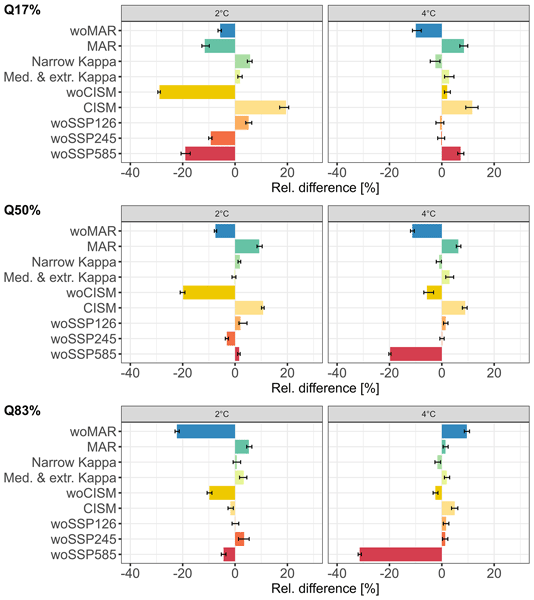
Developing robust protocols to design multi-model ensembles is of primary importance for the uncertainty quantification of sea level projections. Here, we set up a series of computer experiments to reflect design decisions for the prediction of future sea level contribution of the Greenland ice sheet in 2100. We show the importance of including the most extreme climate scenario and the implications of using a single type of numerical model for ice sheets or regional climate.
Mirna Badillo-Interiano, Jérémy Rohmer, Gonéri Le Cozannet, and Virginie Duvat
Nat. Hazards Earth Syst. Sci., 25, 4527–4543, https://doi.org/10.5194/nhess-25-4527-2025, https://doi.org/10.5194/nhess-25-4527-2025, 2025
Short summary
Short summary
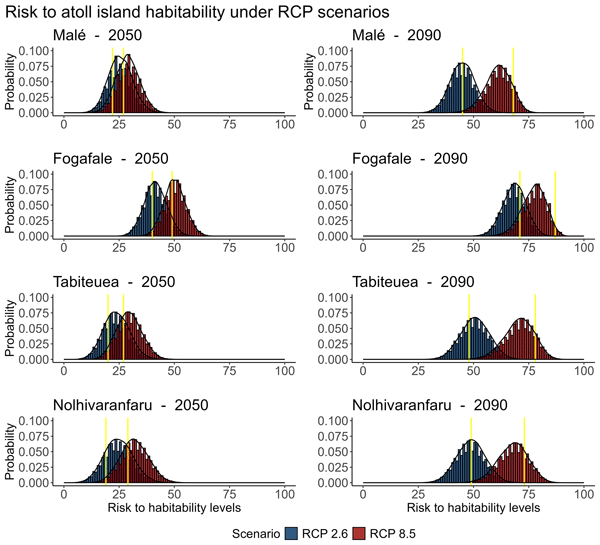
Small islands face increasing threats from climate change. In this context, exploring new modeling approaches is needed to improve climate risk assessments. We applied Bayesian Networks to assess the risk to future habitability on four atoll islands. The findings show that Bayesian Networks are powerful tools for efficiently assessing climate-related risks by combining expert judgments and confidence levels, providing a comprehensive framework to assess risks in data-limited island settings.
Sophie Lecacheux, Jeremy Rohmer, Eva Membrado, Rodrigo Pedreros, Andrea Filippini, Déborah Idier, Servane Gueben-Vénière, Denis Paradis, Alice Dalphinet, and David Ayache
EGUsphere, https://doi.org/10.5194/egusphere-2024-3615, https://doi.org/10.5194/egusphere-2024-3615, 2025
Short summary
Short summary
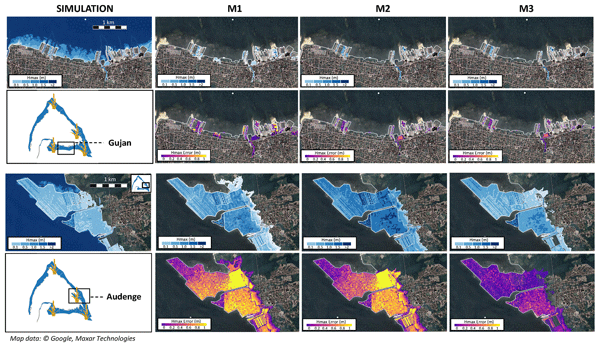
This study comparer three data-driven methodologies to overcome the computational burden of numerical simulations for early warning purpose. They are all based on the statistical analysis of pre-calculated databases, to downscale total sea levels and predict marine flooding maps from offshore metocean forecasts. Conclusions highlight the relevance of metamodel-based approaches for fast prediction and the added value of precalculated databases during the prepardness phase.
Jeremy Rohmer, Stephane Belbeze, and Dominique Guyonnet
SOIL, 10, 679–697, https://doi.org/10.5194/soil-10-679-2024, https://doi.org/10.5194/soil-10-679-2024, 2024
Short summary
Short summary
Machine learning (ML) models have become key ingredients for digital soil mapping. To explain why the ML model is reliable, we apply a popular method from explainable artificial intelligence to the uncertainty prediction, with an application to the mapping of hydrocarbon pollutants on urban soil. We show the benefit of a joint analysis of the influence on the best estimate and the uncertainty to improve communication with end users and support decisions regarding covariates’ characterisation.
Jeremy Rohmer, Remi Thieblemont, Goneri Le Cozannet, Heiko Goelzer, and Gael Durand
The Cryosphere, 16, 4637–4657, https://doi.org/10.5194/tc-16-4637-2022, https://doi.org/10.5194/tc-16-4637-2022, 2022
Short summary
Short summary
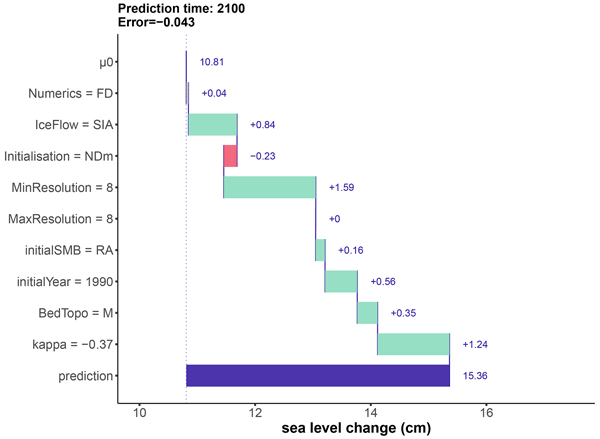
To improve the interpretability of process-based projections of the sea-level contribution from land ice components, we apply the machine-learning-based
SHapley Additive exPlanationsapproach to a subset of a multi-model ensemble study for the Greenland ice sheet. This allows us to quantify the influence of particular modelling decisions (related to numerical implementation, initial conditions, or parametrisation of ice-sheet processes) directly in terms of sea-level change contribution.
Jeremy Rohmer, Deborah Idier, Remi Thieblemont, Goneri Le Cozannet, and François Bachoc
Nat. Hazards Earth Syst. Sci., 22, 3167–3182, https://doi.org/10.5194/nhess-22-3167-2022, https://doi.org/10.5194/nhess-22-3167-2022, 2022
Short summary
Short summary
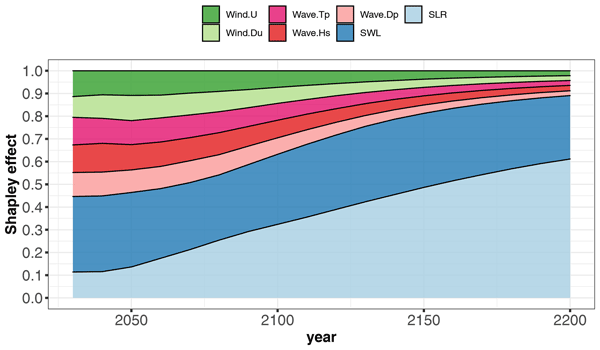
We quantify the influence of wave–wind characteristics, offshore water level and sea level rise (projected up to 2200) on the occurrence of flooding events at Gâvres, French Atlantic coast. Our results outline the overwhelming influence of sea level rise over time compared to the others. By showing the robustness of our conclusions to the errors in the estimation procedure, our approach proves to be valuable for exploring and characterizing uncertainties in assessments of future flooding.
Ryota Wada, Jeremy Rohmer, Yann Krien, and Philip Jonathan
Nat. Hazards Earth Syst. Sci., 22, 431–444, https://doi.org/10.5194/nhess-22-431-2022, https://doi.org/10.5194/nhess-22-431-2022, 2022
Short summary
Short summary
Characterizing extreme wave environments caused by tropical cyclones in the Caribbean Sea near Guadeloupe is difficult because cyclones rarely pass near the location of interest. STM-E (space-time maxima and exposure) model utilizes wave data during cyclones on a spatial neighbourhood. Long-duration wave data generated from a database of synthetic tropical cyclones are used to evaluate the performance of STM-E. Results indicate STM-E provides estimates with small bias and realistic uncertainty.
Rémi Thiéblemont, Gonéri Le Cozannet, Jérémy Rohmer, Alexandra Toimil, Moisés Álvarez-Cuesta, and Iñigo J. Losada
Nat. Hazards Earth Syst. Sci., 21, 2257–2276, https://doi.org/10.5194/nhess-21-2257-2021, https://doi.org/10.5194/nhess-21-2257-2021, 2021
Short summary
Short summary
Sea level rise and its acceleration are projected to aggravate coastal erosion over the 21st century. Resulting shoreline projections are deeply uncertain, however, which constitutes a major challenge for coastal planning and management. Our work presents a new extra-probabilistic framework to develop future shoreline projections and shows that deep uncertainties could be drastically reduced by better constraining sea level projections and improving coastal impact models.
Cited articles
Akaike, H.: A new look at the statistical model identification, IEEE T. Automat. Contr., 19, 716–723, https://doi.org/10.1109/TAC.1974.1100705, 1974. a
Balkema, A. A. and De Haan, L.: Residual life time at great age, Ann. Probab., 2, 792–804, https://doi.org/10.1214/aop/1176996548, 1974. a
Bertin, X., Li, K., Roland, A., Zhang, Y. J., Breilh, J. F., and Chaumillon, E.: A modeling-based analysis of the flooding associated with Xynthia, central Bay of Biscay, Coast. Eng., 94, 80–89, https://doi.org/10.1016/j.coastaleng.2014.08.013, 2014. a
Caillault, C. and Guegan, D.: Empirical estimation of tail dependence using copulas: application to Asian markets, Quant. Financ., 5, 489–501, https://doi.org/10.1080/14697680500147853, 2005. a
Chailan, R., Toulemonde, G., Bouchette, F., Laurent, A., Sevault, F., and Michaud, H.: Spatial assessment of extreme significant waves heights in the Gulf of Lions, Coast. Eng., 17–17, https://doi.org/10.9753/icce.v34.management.17, 2014. a
Chaumillon, E., Bertin, X., Fortunato, A. B., Bajo, M., Schneider, J., Dezileau, L., Walsh, J. P., Michelot, A., Chauveau, E., Créach, A., Hénaff, A., Sauzeau, T., Waeles, B., Gervais, B., Jan, G., Baumann, J., Breilh, J. F., and Pedreros, R.: Storm-induced marine flooding: Lessons from a multidisciplinary approach, Earth-Sci. Rev., 165, 151–184, https://doi.org/10.1016/j.earscirev.2016.12.005, 2017. a
Cheng, Y., Du, J., and Ji, H.: Multivariate joint probability function of earthquake ground motion prediction equations based on vine copula approach, Math. Probl. Eng., 2020, 1697352, https://doi.org/10.1155/2020/1697352, 2020. a
Coles, S., Heffernan, J., and Tawn, J.: Dependence measures for extreme value analyses, Extremes, 2, 339–365, https://doi.org/10.1023/A:1009963131610, 1999. a
Coles, S., Bawa, J., Trenner, L., and Dorazio, P.: An introduction to statistical modeling of extreme values, vol. 208, Springer, https://doi.org/10.1007/978-1-4471-3675-0, 2001. a, b, c, d
Compo, G. P., Whitaker, J. S., Sardeshmukh, P. D., Allan, R. J., McColl, C., Yin, X., Giese, B. S., Vose, R. S., Matsui, N., Ashcroft, L., Auchmann, R., Benoy, M., Bessemoulin, P., Brandsma, T., Brohan, P., Brunet, M., Comeaux, J., Cram, T., Crouthamel, R., Groisman, P. Y., Hersbach, H., Jones, P. D., Jonsson, T., Jourdain, S., Kelly, G., Knapp, K. R., Kruger, A., Kubota, H., Lentini, G., Lorrey, A., Lott, N., Lubker, S. J., Luterbacher, J., Marshall, G. J., Maugeri, M., Mock, C. J., Mok, H. Y., Nordli, O., Przybylak, R., Rodwell, M. J., Ross, T. F., Schuster, D., Srnec, L., Valente, M. A., Vizi, Z., Wang, X. L., Westcott, N., Woollen, J. S., and Worley, S. J.: NOAA/CIRES twentieth century global reanalysis version 2c, NSF National Center for Atmospheric Research, https://doi.org/10.1002/gdj3.25, 2015. a
Czado, C. and Nagler, T.: Vine copula based modeling, Annu. Rev. Stat. Appl., 9, 453–477, https://doi.org/10.1146/annurev-statistics-040220-101153, 2022. a
Dawson, R. J., Dickson, M. E., Nicholls, R. J., Hall, J. W., Walkden, M. J. A., Stansby, P. K., Mokrech, M., Richards, J., Zhou, J., Milligan J. and Jordan, A., Pearson, S., Rees, J., Bates, P. D., Koukoulas, S., and Watkinson, A. R.: Integrated analysis of risks of coastal flooding and cliff erosion under scenarios of long term change, Climatic Change, 95, 249–288, https://doi.org/10.1007/s10584-008-9532-8, 2009. a
de Fondeville, R. and Davison, A. C.: High-dimensional peaks-over-threshold inference, Biometrika, 105, 575–592, https://doi.org/10.1093/biomet/asy026, 2018. a
de Fondeville, R. and Davison, A. C.: Functional peaks-over-threshold analysis, J. R. Stat. Soc. B, 84, 1392–1422, https://doi.org/10.1111/rssb.12498, 2022. a, b, c
De Haan, L. and Resnick, S.: On asymptotic normality of the Hill estimator, Stoch. Models, 14, 849–866, https://doi.org/10.1080/15326349808807504, 1998. a
Dee, D., Balmaseda, M., Balsamo, G., Engelen, R., Simmons, A., and Thépaut, J.-N.: Toward a consistent reanalysis of the climate system, B. Am. Meteorol. Soc., 95, 1235–1248, https://doi.org/10.1175/bams-d-13-00043.1, 2014. a
Dell'Oro, L. and Gaetan, C.: Flexible space-time models for extreme data, Spat. Stat., 68, 100916, https://doi.org/10.1016/j.spasta.2025.100916, 2025. a
Dubey, A. K., Kumar, A., García-Díaz, V., Sharma, A. K., and Kanhaiya, K.: Study and analysis of SARIMA and LSTM in forecasting time series data, Sustainable Energy Technologies and Assessments, 47, 101474, https://doi.org/10.1016/j.seta.2021.101474, 2021. a
Ferreira, A. and de Haan, L.: The generalized Pareto process; with a view towards application and simulation, Bernoulli, 1717–1737, https://doi.org/10.3150/13-BEJ538, 2014. a, b
Ferro, C. A. T. and Segers, J.: Inference for clusters of extreme values, J. R. Stat. Soc. B, 65, 545–556, https://doi.org/10.1111/1467-9868.00401, 2003. a
Genz, A. and Bretz, F.: Computation of Multivariate Normal and t Probabilities, Lecture Notes in Statistics, Springer-Verlag, Heidelberg, https://doi.org/10.1007/978-3-642-01689-9, 2009. a
Gilleland, E. and Katz, R. W.: extRemes 2.0: An Extreme Value Analysis Package in R, J. Stat. Softw., 72, 1–39, https://doi.org/10.18637/jss.v072.i08, 2016. a
Gorse, N. and Rohmer, J.: Nathangos/EXT-Tseries-Meteoceanic: v1, Zenodo [code], https://doi.org/10.5281/zenodo.19063315, 2026. a
Gouldby, B., Méndez, F., Guanche, Y., Rueda, A., and Mínguez, R.: A methodology for deriving extreme nearshore sea conditions for structural design and flood risk analysis, Coast. Eng., 88, 15–26, https://doi.org/10.1016/j.coastaleng.2014.01.012, 2014. a
Haan, L. and Ferreira, A.: Extreme value theory: an introduction, vol. 3, Springer, https://doi.org/10.1007/0-387-34471-3, 2006. a
Hastie, T., Tibshirani, R., and Friedman, J.: The elements of statistical learning, Springer, https://doi.org/10.1007/978-0-387-21606-5, 2009. a
Idier, D., Bertin, X., Thompson, P., and Pickering, M. D.: Interactions between mean sea level, tide, surge, waves and flooding: mechanisms and contributions to sea level variations at the coast, Surv. Geophys., 40, 1603–1630, https://doi.org/10.1007/s10712-019-09549-5, 2019. a, b
Idier, D., Rohmer, J., Pedreros, R., Le Roy, S., Lambert, J., Louisor, J., Le Cozannet, G., and Cornec, E.: Coastal flood: a composite method for past events characterisation providing insights in past, present and future hazards – joining historical, statistical and modelling approaches, Nat. Hazards, 101, 465–501, https://doi.org/10.1007/s11069-020-03882-4, 2020. a, b, c, d, e
Juselius, K.: The cointegrated VAR model: methodology and applications, Oxford University Press, https://doi.org/10.1093/oso/9780199285662.003.0005, 2006. a
Kim, M. and Kokoszka, P.: Extremal correlation coefficient for functional data, arXiv [preprint], https://doi.org/10.48550/arXiv.2405.17318, 2024. a
Kokoszka, P., Stoev, S., and Xiong, Q.: Principal components analysis of regularly varying functions, Bernoulli, 25, 3864–3882, https://doi.org/10.3150/19-BEJ1113, 2019. a
Lê, S., Josse, J., and Husson, F.: FactoMineR: A Package for Multivariate Analysis, J. Stat. Softw., 25, 1–18, https://doi.org/10.18637/jss.v025.i01, 2008. a
Le Roy, S., Pedreros, R., André, C., Paris, F., Lecacheux, S., Marche, F., and Vinchon, C.: Coastal flooding of urban areas by overtopping: dynamic modelling application to the Johanna storm (2008) in Gâvres (France), Nat. Hazards Earth Syst. Sci., 15, 2497–2510, https://doi.org/10.5194/nhess-15-2497-2015, 2015. a
Liaw, A. and Wiener, M.: Classification and Regression by randomForest, R News, 2, 18–22, https://doi.org/10.32614/cran.package.randomforest, 2002. a
Lopez-Paz, D. and Oquab, M.: Revisiting classifier two-sample tests, arXiv [preprint], https://doi.org/10.48550/arXiv.1610.06545, 2016. a, b
Lyard, F. H., Allain, D. J., Cancet, M., Carrère, L., and Picot, N.: FES2014 global ocean tide atlas: design and performance, Ocean Sci., 17, 615–649, https://doi.org/10.5194/os-17-615-2021, 2021. a
Mackay, E., de Hauteclocque, G., Vanem, E., and Jonathan, P.: The effect of serial correlation in environmental conditions on estimates of extreme events, Ocean Eng., 242, 110092, https://doi.org/10.1016/j.oceaneng.2021.110092, 2021. a
Meyer, D., Dimitriadou, E., Hornik, K., Weingessel, A., and Leisch, F.: e1071: Misc Functions of the Department of Statistics, Probability Theory Group (Formerly: E1071), TU Wien, https://doi.org/10.32614/cran.package.e1071, 2023. a
Nagler, T., Schepsmeier, U., Stoeber, J., Brechmann, E. C., Graeler, B., and Erhardt, T.: VineCopula: Statistical Inference of Vine Copulas, CRAN [code], https://doi.org/10.32614/cran.package.vinecopula, 2023. a
Nanty, S., Helbert, C., Marrel, A., Pérot, N., and Prieur, C.: Uncertainty quantification for functional dependent random variables, Computation. Stat., 32, 559–583, https://doi.org/10.1007/s00180-016-0676-0, 2017. a
Nicolae Lerma, A., Bulteau, T., Elineau, S., Paris, F., Durand, P., Anselme, B., and Pedreros, R.: High-resolution marine flood modelling coupling overflow and overtopping processes: framing the hazard based on historical and statistical approaches, Nat. Hazards Earth Syst. Sci., 18, 207–229, https://doi.org/10.5194/nhess-18-207-2018, 2018. a
Perry, R., Panigrahi, S., Bien, J., and Witten, D.: Inference on the proportion of variance explained in principal component analysis, J. Am. Stat. Assoc., 1–11, https://doi.org/10.1080/01621459.2025.2538895, 2025. a
Pugh, D. T.: Tides, surges and mean sea level, John Wiley & Sons Ltd., https://doi.org/10.1016/0025-3227(90)90055-o, 1987. a, b
R Core Team: R: A Language and Environment for Statistical Computing, R Foundation for Statistical Computing, Vienna, Austria, https://doi.org/10.32614/r.manuals, 2023a. a
R Core Team: R: A Language and Environment for Statistical Computing, R Foundation for Statistical Computing, Vienna, Austria, https://doi.org/10.32614/r.manuals, 2023b. a
Reimann, L., Vafeidis, A. T., and Honsel, L. E.: Population development as a driver of coastal risk: Current trends and future pathways, Cambridge Prisms: Coastal Futures, 1, e14, https://doi.org/10.1017/cft.2023.3, 2023. a
Ribatet, M. and Dutang, C.: POT: Generalized Pareto Distribution and Peaks Over Threshold, CRAN [code], https://doi.org/10.32614/cran.package.pot, 2022. a
Rohmer, J., Idier, D., Paris, F., Pedreros, R., and Louisor, J.: Casting light on forcing and breaching scenarios that lead to marine inundation: Combining numerical simulations with a random-forest classification approach, Environ. Modell. Softw., 104, 64–80, https://doi.org/10.1016/j.envsoft.2018.03.003, 2018. a
Rohmer, J., Idier, D., Thieblemont, R., Le Cozannet, G., and Bachoc, F.: Partitioning the contributions of dependent offshore forcing conditions in the probabilistic assessment of future coastal flooding, Nat. Hazards Earth Syst. Sci., 22, 3167–3182, https://doi.org/10.5194/nhess-22-3167-2022, 2022. a
Rüschendorf, L.: On the distributional transform, Sklar's theorem, and the empirical copula process, J. Stat. Plan. Infer., 139, 3921–3927, https://doi.org/10.1016/j.jspi.2009.05.030, 2009. a
Sando, K., Wada, R., Rohmer, J., and Jonathan, P.: Multivariate spatial and spatio-temporal models for extreme tropical cyclone seas, Ocean Eng., 309, 118365, https://doi.org/10.1016/j.oceaneng.2024.118365, 2024. a
Schepsmeier, U.: A goodness-of-fit test for regular vine copula models, Economet. Rev., 38, 25–46, https://doi.org/10.1080/07474938.2016.1222231, 2019. a
Segers, J., Zhao, Y., and Meinguet, T.: Polar decomposition of regularly varying time series in star-shaped metric spaces, Extremes, 20, 539–566, https://doi.org/10.1007/s10687-017-0287-3, 2017. a
Solari, S., Egüen, M., Polo, M. J., and Losada, M. A.: Peaks Over Threshold (POT): A methodology for automatic threshold estimation using goodness of fit p-value, Water Resour. Res., 53, 2833–2849, https://doi.org/10.1002/2016WR019426, 2017. a
Tendijck, S., Jonathan, P., Randell, D., and Tawn, J.: Temporal evolution of the extreme excursions of multivariate k-th order Markov processes with application to oceanographic data, Environmetrics, 35, e2834, https://doi.org/10.1002/env.2834, 2024. a
Thomas, M.: Statistical analysis of extreme values: with applications to insurance, finance, hydrology, and other fields, Birkhäuser Verlag, https://doi.org/10.1007/978-3-7643-7399-3_6, 2001. a
Toimil, A., Losada, I. J., Díaz-Simal, P., Izaguirre, C., and Camus, P.: Multi-sectoral, high-resolution assessment of climate change consequences of coastal flooding, Climatic Change, 145, 431–444, https://doi.org/10.1007/s10584-017-2104-z, 2017. a
Watson, D. S., Blesch, K., Kapar, J., and Wright, M. N.: Adversarial random forests for density estimation and generative modeling, in: International Conference on Artificial Intelligence and Statistics, arXiv [preprint], https://doi.org/10.48550/arXiv.2205.09435, 2023. a
Wessel, J. B., Murphy-Barltrop, C. J., and Simpson, E. S.: Generative machine learning for multivariate angular simulation, Extremes, 1–49, https://doi.org/10.1007/s10687-025-00522-7, 2025. a
White, H.: Maximum likelihood estimation of misspecified models, Econometrica: Journal of the Econometric Society, 1–25, https://doi.org/10.2307/1912526, 1982. a
Short summary
The analysis of the effect of extreme meteoceanic conditions is usually based on physical simulators, which rely on simulated extreme inputs consistent with the observations. However, surge measurements often fail to meet the theoretical assumptions. To address this, we propose a new simulation method which makes it possible to adjust the desired level of extremes after retrieving standard hypotheses. The consistency of simulations with the observations is then validated by using several tools.
The analysis of the effect of extreme meteoceanic conditions is usually based on physical...