Articles | Volume 12, issue 1
https://doi.org/10.5194/ascmo-12-43-2026
© Author(s) 2026. This work is distributed under
the Creative Commons Attribution 4.0 License.
the Creative Commons Attribution 4.0 License.
https://doi.org/10.5194/ascmo-12-43-2026
© Author(s) 2026. This work is distributed under
the Creative Commons Attribution 4.0 License.
the Creative Commons Attribution 4.0 License.

16 Feb 2026
| 16 Feb 2026
Joint probabilistic estimates of temperature and precipitation from tree ring-based reconstructions of the last millennium
Kate Marvel
CORRESPONDING AUTHOR

NASA Goddard Institute for Space Studies, New York, NY 10025, USA
Benjamin Cook
NASA Goddard Institute for Space Studies, New York, NY 10025, USA
Ensheng Weng
Center for Climate Systems Research, Columbia University, New York, NY 10025, USA
Ram Singh
Department of Environmental Studies, New York University, New York, NY 10012, USA
Edward Cook
Tree Ring Laboratory, Lamont-Doherty Earth Observatory, Palisades, NY 10964, USA
Related authors
Kate Marvel and Mark Webb
Earth Syst. Dynam., 16, 317–332, https://doi.org/10.5194/esd-16-317-2025, https://doi.org/10.5194/esd-16-317-2025, 2025
Short summary
Short summary
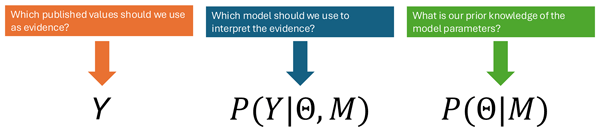
Climate sensitivity (S) to doubled atmospheric carbon dioxide has remained stubbornly uncertain for decades. Multiple lines of evidence can be used to constrain S, but any analysis relies on unavoidable subjective decisions. Here, we present a framework for combining the subjective judgments of multiple experts in a fair and robust way.
Mazen Nakad, Mahmoud Mbarak, Jihad Karaki, Tehreem Qureshi, Matteo Detto, Benjamin I. Cook, Marcos Longo, Géraldine Derroire, Xiangtao Xu, Jeremy Lichstein, Zong-Liang Yang, Pierre Gentine, and Ensheng Weng
EGUsphere, https://doi.org/10.5194/egusphere-2026-145, https://doi.org/10.5194/egusphere-2026-145, 2026
Short summary
Short summary
Because long-term drought and heat experiments are hard to run in tropical forests, we used a computer model to test how less rain and warmer, drier air affect forest growth and water loss at three sites. Forest productivity stayed stable until rainfall dropped below a threshold, but warmer air reduced carbon uptake even when soils were moist. Persistent heat and drought caused far larger declines than brief pulses, raising risks for future carbon storage.
Fangxiu Wan, Chenyu Bian, Ensheng Weng, Yiqi Luo, Kun Huang, and Jianyang Xia
Geosci. Model Dev., 18, 7545–7573, https://doi.org/10.5194/gmd-18-7545-2025, https://doi.org/10.5194/gmd-18-7545-2025, 2025
Short summary
Short summary
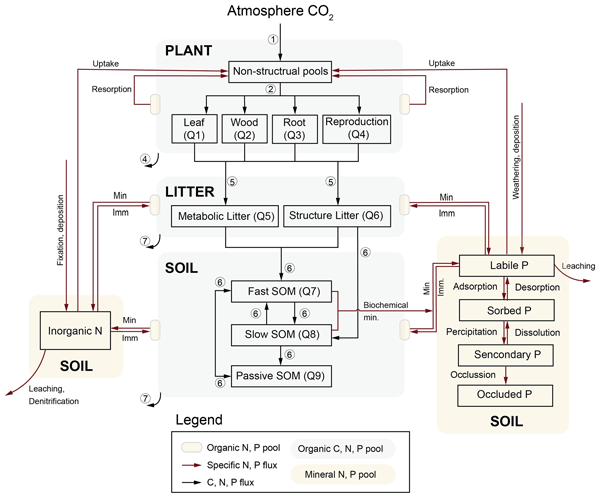
We developed TECO-CNP Sv1.0, a coupled carbon-nitrogen-phosphorus model with data assimilation for subtropical forests. The model effectively captures observed carbon, nitrogen, and phosphorus pools and fluxes, and significantly improves carbon flux estimates through data assimilation. TECO-CNP provides enhanced biogeochemical cycle representations, enabling more reliable predictions of ecosystem carbon cycle responses to global change through efficient parameter optimization.
Kate Marvel and Mark Webb
Earth Syst. Dynam., 16, 317–332, https://doi.org/10.5194/esd-16-317-2025, https://doi.org/10.5194/esd-16-317-2025, 2025
Short summary
Short summary
Climate sensitivity (S) to doubled atmospheric carbon dioxide has remained stubbornly uncertain for decades. Multiple lines of evidence can be used to constrain S, but any analysis relies on unavoidable subjective decisions. Here, we present a framework for combining the subjective judgments of multiple experts in a fair and robust way.
Ensheng Weng, Igor Aleinov, Ram Singh, Michael J. Puma, Sonali S. McDermid, Nancy Y. Kiang, Maxwell Kelley, Kevin Wilcox, Ray Dybzinski, Caroline E. Farrior, Stephen W. Pacala, and Benjamin I. Cook
Geosci. Model Dev., 15, 8153–8180, https://doi.org/10.5194/gmd-15-8153-2022, https://doi.org/10.5194/gmd-15-8153-2022, 2022
Short summary
Short summary
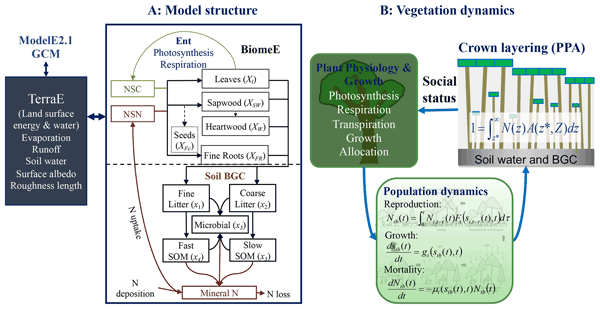
We develop a demographic vegetation model to improve the representation of terrestrial vegetation dynamics and ecosystem biogeochemical cycles in the Goddard Institute for Space Studies ModelE. The individual-based competition for light and soil resources makes the modeling of eco-evolutionary optimality possible. This model will enable ModelE to simulate long-term biogeophysical and biogeochemical feedbacks between the climate system and land ecosystems at decadal to centurial temporal scales.
Rob Wilson, Kathy Allen, Patrick Baker, Gretel Boswijk, Brendan Buckley, Edward Cook, Rosanne D'Arrigo, Dan Druckenbrod, Anthony Fowler, Margaux Grandjean, Paul Krusic, and Jonathan Palmer
Biogeosciences, 18, 6393–6421, https://doi.org/10.5194/bg-18-6393-2021, https://doi.org/10.5194/bg-18-6393-2021, 2021
Short summary
Short summary
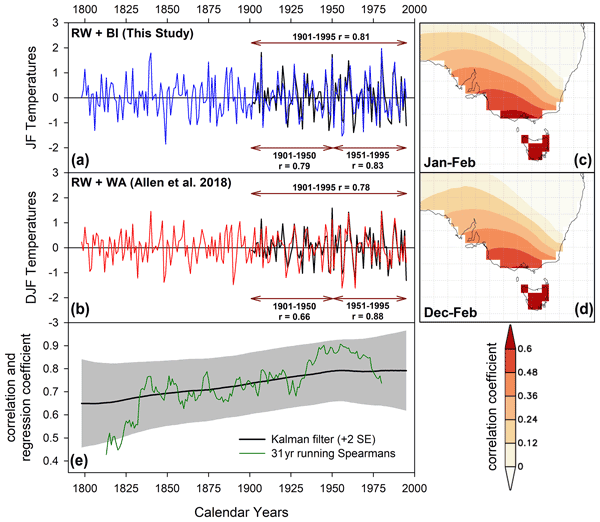
We explore blue intensity (BI) – a low-cost method for measuring ring density – to enhance palaeoclimatology in Australasia. Calibration experiments, using several conifer species from Tasmania and New Zealand, model 50–80 % of the summer temperature variance. The implications of these results have profound consequences for high-resolution paleoclimatology in Australasia, as the speed and cheapness of BI generation could lead to a step change in our understanding of past climate in the region.
Cited articles
Abril-Pla, O., Andreani, V., Carroll, C., Dong, L., Fonnesbeck, C. J., Kochurov, M., Kumar, R., Lao, J., Luhmann, C. C., Martin, O. A., Osthere, M., Vieira, R., Wiecki, T., and Zinkov, R.: PyMC: a modern, and comprehensive probabilistic programming framework in Python, PeerJ Computer Science, 9, e1516, https://doi.org/10.7717/peerj-cs.1516, 2023. a, b
Annan, J. D., Hargreaves, J. C., and Mauritsen, T.: A new global surface temperature reconstruction for the Last Glacial Maximum, Climate of the Past, 18, 1883–1896, https://doi.org/10.5194/cp-18-1883-2022, 2022. a
Bastien F., Lamblin P., bergeron, Willard, B. T., Goodfellow, I., Pascanu, R., carriepl, Breuleux, O., notoraptor, Warde-Farley, D., Xue, R., Bergstra, J., harlouci, Affan, M., Sundararaman, R., Askari, R., maqianlie, Panneerselvam, S., Belopolsky, A., and Lowin, J.: pymc-devs/pytensor: rel-2.8.12, Zenodo [code], https://doi.org/10.5281/zenodo.7494433, 2022. a
Brooks, S. P.: Bayesian computation: a statistical revolution, Philosophical Transactions of the Royal Society of London Series A: Mathematical, Physical and Engineering Sciences, 361, 2681–2697, 2003. a
Burgdorf, A.-M., Brönnimann, S., and Franke, J.: Two types of North American droughts related to different atmospheric circulation patterns, Climate of the Past, 15, 2053–2065, https://doi.org/10.5194/cp-15-2053-2019, 2019. a
Cook, B. I., Smerdon, J. E., Seager, R., and Cook, E. R.: Pan-Continental Droughts in North America over the Last Millennium, Journal of Climate, 27, 383–397, https://doi.org/10.1175/jcli-d-13-00100.1, 2014. a
Cook, B. I., Ault, T. R., and Smerdon, J. E.: Unprecedented 21st century drought risk in the American Southwest and Central Plains, Science Advances, 1, https://doi.org/10.1126/sciadv.1400082, 2015a. a
Cook, B. I., Cook, E. R., Smerdon, J. E., Seager, R., Williams, A. P., Coats, S., Stahle, D. W., and Díaz, J. V.: North American megadroughts in the Common Era: reconstructions and simulations, WIREs Climate Change, 7, 411–432, https://doi.org/10.1002/wcc.394, 2016. a
Cook, B. I., Smerdon, J. E., Cook, E. R., Williams, A. P., Anchukaitis, K. J., Mankin, J. S., Allen, K., Andreu-Hayles, L., Ault, T. R., Belmecheri, S., Coats, S., Coulthard, B., Fosu, B., Grierson, P., Griffin, D., Herrera, D. A., Ionita, M., Lehner, F., Leland, C., Marvel, K., Morales, M. S., Mishra, V., Ngoma, J., Nguyen, H. T. T., O'Donnell, A., Palmer, J., Rao, M. P., Rodriguez-Caton, M., Seager, R., Stahle, D. W., Stevenson, S., Thapa, U. K., Varuolo-Clarke, A. M., and Wise, E. K.: Megadroughts in the Common Era and the Anthropocene, Nature Reviews Earth & Environment, 3, 741–757, 2022. a
Cook, B. I., Williams, A. P., Smerdon, J. E., Marvel, K., and Seager, R.: Megapluvials in Southwestern North America, AGU Advances, 6, e2024AV001508, https://doi.org/10.1029/2024av001508, 2025. a
Cook, E., Lall, U., Woodhouse, C., and Meko, D.: NOAA/WDS Paleoclimatology – Cook et al. 2004 North American Drought Atlas PDSI Reconstructions, NOAA National Centers for Environmental Information [data set], https://doi.org/10.25921/GRRG-Z534, 2005. a
Cook, E. R., Seager, R., Heim, R. R., Vose, R. S., Herweijer, C., and Woodhouse, C.: Megadroughts in North America: placing IPCC projections of hydroclimatic change in a long‐term palaeoclimate context, Journal of Quaternary Science, 25, 48–61, https://doi.org/10.1002/jqs.1303, 2009. a
Cook, E. R., Anchukaitis, K. J., Buckley, B. M., D'Arrigo, R. D., Jacoby, G. C., and Wright, W. E.: Asian monsoon failure and megadrought during the last millennium, Science, 328, 486–489, 2010a. a
ook, E. R., Seager, R., Kushnir, Y., Briffa, K. R., Buntgen, U., Frank, D., Krusic, P. J., Tegel, W., van der Schrier, G., Andreu-Hayles, L., Baillie, M., Baittinger, C., Bleicher, N., Bonde, N., Brown, D., Carrer, M., Cooper, R., Cufar, K., Dittmar, C., Esper, J., Griggs, C., Gunnarson, B., Gunther, B., Gutierrez, E., Haneca, K., Helama, S., Herzig, F., Heussner, K.-U., Hofmann, J., Janda, P., Kontic, R., Kose, N., Kynci, T., Levanic, T., Linderholm, H., Manning, S., Melvin, T. M., Miles, D., Neuwirth, B., Nicolussi, K., Nola, P., Panayotov, M., Popa, I., Rothe, A., Seftigen, K., Seim, A., Svarva, H., Svoboda, M., Thun, T., Timonen, M., Touchan, R., Trotsiuk, V., Trouet, V., Walder, F., Wazny, T., Wilson, R., and Zang, C.: Old World megadroughts and pluvials during the Common Era, Science advances, 1, e1500561, https://doi.org/10.1126/sciadv.1500561, 2015b. a
Dai, A.: Characteristics and trends in various forms of the Palmer Drought Severity Index during 1900–2008, Journal of Geophysical Research: Atmospheres, 116, https://doi.org/10.1029/2010JD015541, 2011. a
Fye, F. K., Stahle, D. W., and Cook, E. R.: Paleoclimatic Analogs to Twentieth-Century Moisture Regimes Across the United States, Bulletin of the American Meteorological Society, 84, 901–910, https://doi.org/10.1175/bams-84-7-901, 2003. a
Gelman, A., Carlin, J. B., Stern, H. S., and Rubin, D. B.: Bayesian data analysis, Chapman and Hall/CRC, ISBN 158488388X, 1995. a
Gillett, N. P., Kirchmeier-Young, M., Ribes, A., Shiogama, H., Hegerl, G. C., Knutti, R., Gastineau, G., John, J. G., Li, L., Nazarenko, L., Rosenbloom, N., Seland, Ø., Wu, T., Yukimoto, S., and Ziehn, T.: Constraining human contributions to observed warming since the pre-industrial period, Nature Climate Change, 11, 207–212, 2021. a
Guttman, N. B.: accepting the standardized precipitation index: a calculation algorithm1, JAWRA Journal of the American Water Resources Association, 35, 311–322, https://doi.org/10.1111/j.1752-1688.1999.tb03592.x, 1999. a
Haslett, J., Whiley, M., Bhattacharya, S., Salter-Townshend, M., Wilson, S. P., Allen, J., Huntley, B., and Mitchell, F.: Bayesian palaeoclimate reconstruction, Journal of the Royal Statistical Society Series A: Statistics in Society, 169, 395–438, 2006. a
Hegerl, G. C., Hasselmann, K., Cubasch, U., Mitchell, J. F., Roeckner, E., Voss, R., and Waszkewitz, J.: Multi-fingerprint detection and attribution analysis of greenhouse gas, greenhouse gas-plus-aerosol and solar forced climate change, Climate Dynamics, 13, 613–634, 1997. a
Hoffman, M. D. and Gelman, A., et al.: The No-U-Turn sampler: adaptively setting path lengths in Hamiltonian Monte Carlo, ArXiv [preprint], https://doi.org/10.48550/arXiv.1111.4246, 2014. a, b
Kumar, R., Carroll, C., Hartikainen, A., and Martin, O.: ArviZ a unified library for exploratory analysis of Bayesian models in Python, Journal of Open Source Software, 4, 1143, https://doi.org/10.21105/joss.01143, 2019. a
Kushnir, Y., Seager, R., Ting, M., Naik, N., and Nakamura, J.: Mechanisms of Tropical Atlantic SST Influence on North American Precipitation Variability, Journal of Climate, 29, 680–699, https://doi.org/10.1175/JCLI-D-14-00751.1, 2016. a
Lenssen, N. J., Schmidt, G. A., Hansen, J. E., Menne, M. J., Persin, A., Ruedy, R., and Zyss, D.: Improvements in the GISTEMP uncertainty model, Journal of Geophysical Research: Atmospheres, 124, 6307–6326, 2019. a
Lewandowski, D., Kurowicka, D., and Joe, H.: Generating random correlation matrices based on vines and extended onion method, Journal of mULTIVARIATE Analysis, 100, 1989–2001, 2009. a
Martin, O.: Bayesian analysis with Python: introduction to statistical modeling and probabilistic programming using PyMC3 and ArviZ, Packt Publishing Ltd, ISBN 1789341655, 2018. a
Marvel, K. and Cook, B. I.: Using machine learning to identify novel hydroclimate states, Philosophical Transactions of the Royal Society A, 380, 20210287, https://doi.org/10.1098/rsta.2021.0287, 2022. a
Miralles, D. G., Teuling, A. J., Van Heerwaarden, C. C., and De Arellano, J. V.-G.: Mega-heatwave temperatures due to combined soil desiccation and atmospheric heat accumulation, Nature Geoscience, 7, 345–349, 2014. a
Morales, M. S., Cook, E. R., Barichivich, J., Christie, D. A., Villalba, R., LeQuesne, C., Srur, A. M., Ferrero, M. E., González-Reyes, Á., Couvreux, F., Matskovsky, V., Aravena, J. C., Lara, A., Mundo, I. A., Rojas, F., Prieto, M. R., Smerdon, J. E., Bianchi, L. O., Masiokas, M. H., Urrutia-Jalabert, R., Rodriguez-Catón, M., Muñoz, A. A., Rojas-Badilla, M., Alvarez, C., Lopez, L., Luckman, B. H., Lister, D., Harris, I., Jones, P. D., Williams, A. P., Velazquez, G., Aliste, D., Aguilera-Betti, I., Marcotti, E., Flores, F., Muñoz, T., Cuq, E., and Boninsegna, J. A.: Six hundred years of South American tree rings reveal an increase in severe hydroclimatic events since mid-20th century, Proceedings of the National Academy of Sciences, 117, 16816–16823, 2020. a
netzeroasap: netzeroasap/Reconstruction: Published to Github, Zenodo [code], https://doi.org/10.5281/zenodo.17604226, 2025. a
PAGES 2k Consortium: Continental-scale temperature variability during the past two millennia, Nature Geoscience, 6, 339–346, https://doi.org/10.1038/ngeo1797, 2013. a
Palmer, J. G., Cook, E. R., Turney, C. S., Allen, K., Fenwick, P., Cook, B. I., O'Donnell, A., Lough, J., Grierson, P., and Baker, P.: Drought variability in the eastern Australia and New Zealand summer drought atlas (ANZDA, CE 1500–2012) modulated by the Interdecadal Pacific Oscillation, Environmental Research Letters, 10, 124002, https://doi.org/10.1088/1748-9326/10/12/124002, 2015. a
Palmer, W. C.: Meteorological drought. Research Paper No. 45. Washington, DC: US Department of Commerce, Weather Bureau, p. 59, https://www.droughtmanagement.info/literature/USWB_Meteorological_Drought_1965.pdf (last access: 9 February 2026), 1965. a
anter, B. B. D., Painter, J. F. J., Mears, C. a, Doutriaux, C., Caldwell, P., Arblaster, J. M., Cameron-Smith, P. J., Gillett, N. P., Gleckler, P. J., Lanzante, J., Perlwitz, J., Solomon, S., Stott, P. a, Taylor, K. E., Terray, L., Thorne, P. W., Wehner, M. F., Wentz, F. J., Wigley, T. M. L., Wilcox, L. J., and Zou, C.-Z.: Identifying human influences on atmospheric temperature, Proceedings of the National Academy of Sciences, 110, 26–33, 2013. a
Schubert, S. D., Suarez, M. J., Pegion, P., Koster, R. D., and Bacmeister, J.: ENSO and Pacific Decadal Variability and U.S. Precipitation: Mechanisms and Predictability, Journal of Climate, 23, 1585–1602, https://doi.org/10.1175/2009JCLI3188.1, 2010. a
Seneviratne, S. I., Corti, T., Davin, E. L., Hirschi, M., Jaeger, E. B., Lehner, I., Orlowsky, B., and Teuling, A. J.: Investigating soil moisture–climate interactions in a changing climate: A review, Earth-Science Reviews, 99, 125–161, 2010. a
Stahle, D. W., Fye, F. K., Cook, E. R., and Griffin, R. D.: Tree-ring reconstructed megadroughts over North America since A.D. 1300, Climatic Change, 83, 133–149, https://doi.org/10.1007/s10584-006-9171-x, 2007. a
Stahle, D. W., Cook, E. R., Burnette, D. J., Villanueva, J., Cerano, J., Burns, J. N., Griffin, D., Cook, B. I., Acuña, R., Torbenson, M. C., Szejner, P., Howard, I. M.: The Mexican Drought Atlas: Tree-ring reconstructions of the soil moisture balance during the late pre-Hispanic, colonial, and modern eras, Quaternary Science Reviews, 149, 34–60, 2016. a
Steiger, N. J., Smerdon, J. E., Cook, E. R., and Cook, B. I.: A reconstruction of global hydroclimate and dynamical variables over the Common Era, Scientific Data, 5, https://doi.org/10.1038/sdata.2018.86, 2018. a
Tardif, R., Hakim, G. J., Perkins, W. A., Horlick, K. A., Erb, M. P., Emile-Geay, J., Anderson, D. M., Steig, E. J., and Noone, D.: Last Millennium Reanalysis with an expanded proxy database and seasonal proxy modeling, Climate of the Past, 15, 1251–1273, https://doi.org/10.5194/cp-15-1251-2019, 2019. a
Tierney, J. E., Poulsen, C. J., Montañez, I. P., Bhattacharya, T., Feng, R., Ford, H. L., Hönisch, B., Inglis, G. N., Petersen, S. V., Sagoo, N., Tabor, C. R., Thirumalai, K., Zhu, J., Burls, N. J., Foster, G. L., Goddéris, Y., Huber, B. T., Ivany, L. C., Kirtland Turner, S., Lunt, D. J., McElwain, J. C., Mills, B. J. W., Otto-Bliesner, B. L., Ridgwell, A., and Zhang, Y. G.: Past climates inform our future, Science, 370, https://doi.org/10.1126/science.aay3701, 2020a. a
Tierney, J. E., Zhu, J., King, J., Malevich, S. B., Hakim, G. J., and Poulsen, C. J.: Glacial cooling and climate sensitivity revisited, Nature, 584, 569–573, 2020b. a
Tingley, M. P. and Huybers, P.: A Bayesian algorithm for reconstructing climate anomalies in space and time. Part I: Development and applications to paleoclimate reconstruction problems, Journal of Climate, 23, 2759–2781, 2010. a
Wells, N., Goddard, S., and Hayes, M. J.: A self-calibrating Palmer drought severity index, Journal of Climate, 17, 2335–2351, 2004. a
Williams, A. P., Cook, E. R., Smerdon, J. E., Cook, B. I., Abatzoglou, J. T., Bolles, K., Baek, S. H., Badger, A. M., and Livneh, B.: Large contribution from anthropogenic warming to an emerging North American megadrought, Science, 368, 314–318, 2020. a
Worster, D.: Dust bowl: the southern plains in the 1930s, Oxford University Press, ISBN 9780195174885, 2004. a
Zhang, X., Wu, Z., Chi, X., and Li, Y.: Southwest Pacific Spring SST Anomalies as a Predictor of North American Autumn Surface Air Temperature, Journal of Climate, 36, 5835–5849, https://doi.org/10.1175/JCLI-D-22-0783.1, 2023. a
Short summary
Using information derived from tree-rings, we reconstruct possible combinations of past temperatures and precipitation amounts. This lets us put current changes in context and shows, for example, that the 1930s were likely the driest decade on record in central Kansas, while the late 20th century was likely the wettest period on record in the North American southwest.
Using information derived from tree-rings, we reconstruct possible combinations of past...


