Articles | Volume 12, issue 1
https://doi.org/10.5194/ascmo-12-149-2026
© Author(s) 2026. This work is distributed under
the Creative Commons Attribution 4.0 License.
the Creative Commons Attribution 4.0 License.
https://doi.org/10.5194/ascmo-12-149-2026
© Author(s) 2026. This work is distributed under
the Creative Commons Attribution 4.0 License.
the Creative Commons Attribution 4.0 License.

05 May 2026
| 05 May 2026
Improving multisite precipitation generators based on generalised linear models
Jakob Benjamin Wessel
CORRESPONDING AUTHOR

Department of Mathematics and Statistics, University of Exeter, Exeter, United Kingdom
Richard E. Chandler
Department of Statistical Science, University College London, London, United Kingdom
Related authors
Andreia F. S. Ribeiro, Maik Biling, Kirsten Thonicke, Werner von Bloh, Jakob Wessel, Sabine Undorf, Matthias Forkel, and Jakob Zscheischler
EGUsphere, https://doi.org/10.5194/egusphere-2026-2952, https://doi.org/10.5194/egusphere-2026-2952, 2026
Short summary
Short summary
Wildfires are becoming more extreme, yet our state-of-the-art tools fail to capture the full risk. We simulate a large ensemble of wildfire simulations capturing a broader range of physically plausible extreme wildfire events beyond what observations alone can reveal. Extreme fire danger alone does not explain the worst impacts: ignitions, fuel and vegetation-fire feedback need to be incorporated. This modelling framework is transferable to other climate-impact sectors beyond wildfires.
Douglas I. Kelley, Chantelle Burton, Francesca Di Giuseppe, Matthew W. Jones, Maria L. F. Barbosa, Esther Brambleby, Joe R. McNorton, Zhongwei Liu, Anna S. I. Bradley, Katie Blackford, Eleanor Burke, Andrew Ciavarella, Enza Di Tomaso, Jonathan Eden, Igor José M. Ferreira, Lukas Fiedler, Andrew J. Hartley, Theodore R. Keeping, Seppe Lampe, Anna Lombardi, Guilherme Mataveli, Yuquan Qu, Patrícia S. Silva, Fiona R. Spuler, Carmen B. Steinmann, Miguel Ángel Torres-Vázquez, Renata Veiga, Dave van Wees, Jakob B. Wessel, Emily Wright, Bibiana Bilbao, Mathieu Bourbonnais, Cong Gao, Carlos M. Di Bella, Kebonye Dintwe, Victoria M. Donovan, Sarah Harris, Elena A. Kukavskaya, Aya Brigitte N'Dri, Cristina Santín, Galia Selaya, Johan Sjöström, John T. Abatzoglou, Niels Andela, Rachel Carmenta, Emilio Chuvieco, Louis Giglio, Douglas S. Hamilton, Stijn Hantson, Sarah Meier, Mark Parrington, Mojtaba Sadegh, Jesus San-Miguel-Ayanz, Fernando Sedano, Marco Turco, Guido R. van der Werf, Sander Veraverbeke, Liana O. Anderson, Hamish Clarke, Paulo M. Fernandes, and Crystal A. Kolden
Earth Syst. Sci. Data, 17, 5377–5488, https://doi.org/10.5194/essd-17-5377-2025, https://doi.org/10.5194/essd-17-5377-2025, 2025
Short summary
Short summary
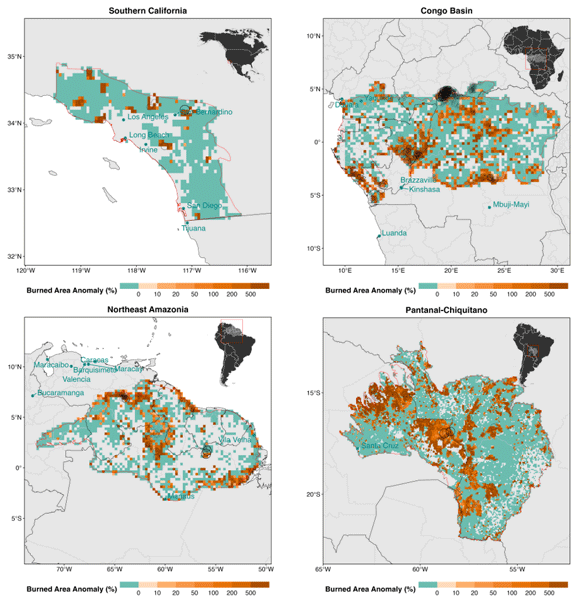
The second State of Wildfires report examines extreme wildfire events from 2024 to early 2025. It analyses key regional events in Southern California, Northeast Amazonia, Pantanal–Chiquitano, and the Congo Basin, assessing their drivers and predictability and attributing them to climate change and land use. Seasonal outlooks and decadal projections are provided. Climate change greatly increased the likelihood of these fires, and without strong mitigation, such events will become more frequent.
Matthew W. Jones, Douglas I. Kelley, Chantelle A. Burton, Francesca Di Giuseppe, Maria Lucia F. Barbosa, Esther Brambleby, Andrew J. Hartley, Anna Lombardi, Guilherme Mataveli, Joe R. McNorton, Fiona R. Spuler, Jakob B. Wessel, John T. Abatzoglou, Liana O. Anderson, Niels Andela, Sally Archibald, Dolors Armenteras, Eleanor Burke, Rachel Carmenta, Emilio Chuvieco, Hamish Clarke, Stefan H. Doerr, Paulo M. Fernandes, Louis Giglio, Douglas S. Hamilton, Stijn Hantson, Sarah Harris, Piyush Jain, Crystal A. Kolden, Tiina Kurvits, Seppe Lampe, Sarah Meier, Stacey New, Mark Parrington, Morgane M. G. Perron, Yuquan Qu, Natasha S. Ribeiro, Bambang H. Saharjo, Jesus San-Miguel-Ayanz, Jacquelyn K. Shuman, Veerachai Tanpipat, Guido R. van der Werf, Sander Veraverbeke, and Gavriil Xanthopoulos
Earth Syst. Sci. Data, 16, 3601–3685, https://doi.org/10.5194/essd-16-3601-2024, https://doi.org/10.5194/essd-16-3601-2024, 2024
Short summary
Short summary
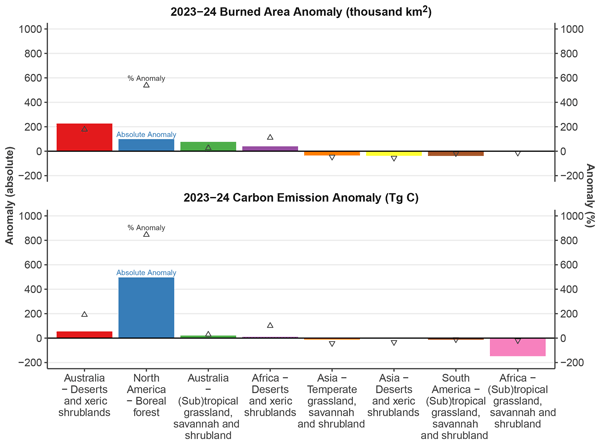
This inaugural State of Wildfires report catalogues extreme fires of the 2023–2024 fire season. For key events, we analyse their predictability and drivers and attribute them to climate change and land use. We provide a seasonal outlook and decadal projections. Key anomalies occurred in Canada, Greece, and western Amazonia, with other high-impact events catalogued worldwide. Climate change significantly increased the likelihood of extreme fires, and mitigation is required to lessen future risk.
Andreia F. S. Ribeiro, Maik Biling, Kirsten Thonicke, Werner von Bloh, Jakob Wessel, Sabine Undorf, Matthias Forkel, and Jakob Zscheischler
EGUsphere, https://doi.org/10.5194/egusphere-2026-2952, https://doi.org/10.5194/egusphere-2026-2952, 2026
Short summary
Short summary
Wildfires are becoming more extreme, yet our state-of-the-art tools fail to capture the full risk. We simulate a large ensemble of wildfire simulations capturing a broader range of physically plausible extreme wildfire events beyond what observations alone can reveal. Extreme fire danger alone does not explain the worst impacts: ignitions, fuel and vegetation-fire feedback need to be incorporated. This modelling framework is transferable to other climate-impact sectors beyond wildfires.
Douglas I. Kelley, Chantelle Burton, Francesca Di Giuseppe, Matthew W. Jones, Maria L. F. Barbosa, Esther Brambleby, Joe R. McNorton, Zhongwei Liu, Anna S. I. Bradley, Katie Blackford, Eleanor Burke, Andrew Ciavarella, Enza Di Tomaso, Jonathan Eden, Igor José M. Ferreira, Lukas Fiedler, Andrew J. Hartley, Theodore R. Keeping, Seppe Lampe, Anna Lombardi, Guilherme Mataveli, Yuquan Qu, Patrícia S. Silva, Fiona R. Spuler, Carmen B. Steinmann, Miguel Ángel Torres-Vázquez, Renata Veiga, Dave van Wees, Jakob B. Wessel, Emily Wright, Bibiana Bilbao, Mathieu Bourbonnais, Cong Gao, Carlos M. Di Bella, Kebonye Dintwe, Victoria M. Donovan, Sarah Harris, Elena A. Kukavskaya, Aya Brigitte N'Dri, Cristina Santín, Galia Selaya, Johan Sjöström, John T. Abatzoglou, Niels Andela, Rachel Carmenta, Emilio Chuvieco, Louis Giglio, Douglas S. Hamilton, Stijn Hantson, Sarah Meier, Mark Parrington, Mojtaba Sadegh, Jesus San-Miguel-Ayanz, Fernando Sedano, Marco Turco, Guido R. van der Werf, Sander Veraverbeke, Liana O. Anderson, Hamish Clarke, Paulo M. Fernandes, and Crystal A. Kolden
Earth Syst. Sci. Data, 17, 5377–5488, https://doi.org/10.5194/essd-17-5377-2025, https://doi.org/10.5194/essd-17-5377-2025, 2025
Short summary
Short summary
The second State of Wildfires report examines extreme wildfire events from 2024 to early 2025. It analyses key regional events in Southern California, Northeast Amazonia, Pantanal–Chiquitano, and the Congo Basin, assessing their drivers and predictability and attributing them to climate change and land use. Seasonal outlooks and decadal projections are provided. Climate change greatly increased the likelihood of these fires, and without strong mitigation, such events will become more frequent.
Matthew W. Jones, Douglas I. Kelley, Chantelle A. Burton, Francesca Di Giuseppe, Maria Lucia F. Barbosa, Esther Brambleby, Andrew J. Hartley, Anna Lombardi, Guilherme Mataveli, Joe R. McNorton, Fiona R. Spuler, Jakob B. Wessel, John T. Abatzoglou, Liana O. Anderson, Niels Andela, Sally Archibald, Dolors Armenteras, Eleanor Burke, Rachel Carmenta, Emilio Chuvieco, Hamish Clarke, Stefan H. Doerr, Paulo M. Fernandes, Louis Giglio, Douglas S. Hamilton, Stijn Hantson, Sarah Harris, Piyush Jain, Crystal A. Kolden, Tiina Kurvits, Seppe Lampe, Sarah Meier, Stacey New, Mark Parrington, Morgane M. G. Perron, Yuquan Qu, Natasha S. Ribeiro, Bambang H. Saharjo, Jesus San-Miguel-Ayanz, Jacquelyn K. Shuman, Veerachai Tanpipat, Guido R. van der Werf, Sander Veraverbeke, and Gavriil Xanthopoulos
Earth Syst. Sci. Data, 16, 3601–3685, https://doi.org/10.5194/essd-16-3601-2024, https://doi.org/10.5194/essd-16-3601-2024, 2024
Short summary
Short summary
This inaugural State of Wildfires report catalogues extreme fires of the 2023–2024 fire season. For key events, we analyse their predictability and drivers and attribute them to climate change and land use. We provide a seasonal outlook and decadal projections. Key anomalies occurred in Canada, Greece, and western Amazonia, with other high-impact events catalogued worldwide. Climate change significantly increased the likelihood of extreme fires, and mitigation is required to lessen future risk.
Cited articles
Ailliot, P., Thompson, C., and Thomson, P.: Space-time modelling of precipitation using a hidden Markov model and censored Gaussian distributions, Appl. Statist., 58, 405–426, 2009. a
Ambrosino, C., Chandler, R. E., and Todd, M. C.: Southern African monthly rainfall variability: An analysis based on generalized linear models, J. Climate, 24, https://doi.org/10.1175/2010JCLI3924.1, 2011. a
Andrianakis, I. and Challenor, P. G.: The effect of the nugget on Gaussian process emulators of computer models, Comput. Stat. Data An., 56, 4215–4228, https://doi.org/10.1016/j.csda.2012.04.020, 2012. a
Asong, Z. E., Khaliq, M. N., and Wheater, H. S.: Multisite multivariate modeling of daily precipitation and temperature in the Canadian Prairie Provinces using generalized linear models, Clim. Dynam., 47, 2901–2921, https://doi.org/10.1007/s00382-016-3004-z, 2016. a
Ayar, P. V., Vrac, M., Bastin, S., Carreau, J., Deque, M., and Gallardo, C.: Intercomparison of statistical and dynamical downscaling models under the EURO- and MED-CORDEX initiative framework: present climate evaluations, Clim. Dynam., 46, 1301–1329, 2016. a
Beck, H. E., Zimmermann, N. E., McVicar, T. R., Vergopolan, N., Berg, A., and Wood, E. F.: Present and future Köppen-Geiger climate classification maps at 1-km resolution, Scientific Data, 5, 180214, https://doi.org/10.1038/sdata.2018.214, 2018. a
Beckmann, B.-R. and Buishand, T. A.: Statistical downscaling relationships for precipitation in the Netherlands and North Germany, Int. J. Climatol., 22, 15–32, 2002. a
Beersma, J. J. and Buishand, T. A.: Multi-site simulation of daily precipitation and temperature conditional on the atmospheric circulation, Clim. Res., 25, 121–133, 2003. a
Belzile, L. R., Dutang, C., Northrop, P. J., and Opitz, T.: A modeler's guide to extreme value software, Extremes, 26, 595–638, https://doi.org/10.1007/s10687-023-00475-9, 2023. a
Beven, K.: Issues in generating stochastic observables for hydrological models, Hydrol. Process., 35, e14203, https://doi.org/10.1002/hyp.14203, 2021. a
Buishand, T. and Brandsma, T.: Multisite simulation of daily precipitation and temperature in the Rhine basin by nearest-neighbor resampling, Water Resour. Res., 37, 2761–2776, 2001. a
Cameron, D., Beven, K., and Tawn, J.: Modelling extreme rainfalls using a modified random pulse Bartlett-Lewis stochastic rainfall model (with uncertainty), Adv. Water Resour., 24, 203–211, 2001. a
Cavanaugh, J. E. and Shumway, R. H.: A Bootstrap Variant of AIC for State-Space Model Selection, Stat. Sinica, 7, 473–496, https://www.jstor.org/stable/24306089 (last access: 1 May 2026), 1997. a
Chandler, R. E.: On the use of generalized linear models for interpreting climate variability, Environmetrics, 16, https://doi.org/10.1002/env.731, 2005. a, b
Chandler, R. E. and Bate, S.: Inference for clustered data using the independence loglikelihood, Biometrika, 94, 167–183, https://doi.org/10.1093/biomet/asm015, 2007. a
Chandler, R. E. and Wheater, H. S.: Analysis of rainfall variability using Generalized Linear Models — a case study from the West of Ireland., Water Resour. Res., 38, No.10, https://doi.org/10.1029/2001WR000906, 2002. a
Chandler, R. E., Isham, V., Bellone, E., Yang, C., and Northrop, P.: Space-Time Modeling of Rainfall for Continuous Simulation, in: Statistical Methods for Spatio-Temporal Systems, no. 107 in Monographs on Statistics and Applied Probability, 1st edn., CRC Press, pp. 177–215, https://doi.org/10.1201/9781420011050, 2007. a, b
Chandler, R. E., Bates, B. C., and Charles, S. P.: Rainfall trends in southwest Western Australia, in: Statistical Methods for Trend Detection and Analysis in the Environmental Sciences, edited by: Chandler, R. E. and Scott, E. M., John Wiley and Sons, Chichester, pp. 283–306, https://doi.org/10.1002/9781119991571.ch8, 2011. a
Chandler, R. E., Isham, V., Northrop, P., Wheater, H., Onof, C., and Leith, N.: Uncertainty in rainfall inputs, in: Applied Uncertainty Analysis for Flood Risk Management, edited by: Beven, K. and Hall, J., Imperial College Press, London, pp. 101–152, ISBN 1848162707, 2014. a
Charles, S., Bates, B., and Hughes, J.: A spatiotemporal model for downscaling precipitation occurrence and amounts, J. Geophys. Res-Atmos., 104, 31657–31669, 1999. a
Chun, K. P., Mamet, S. D., Metsaranta, J., Barr, A., Johnstone, J., and Wheater, H.: A novel stochastic method for reconstructing daily precipitation time-series using tree-ring data from the western Canadian Boreal Forest, Dendrochronologia, 44, 9–18, https://doi.org/10.1016/j.dendro.2017.01.003, 2017. a
Coles, S.: An Introduction to Statistical Modeling of Extreme Values, Springer Series in Statistics, Springer, London, https://doi.org/10.1007/978-1-4471-3675-0, 2001. a
Davison, A. C.: Statistical Models, Cambridge University Press, Cambridge, ISBN 0-521-77339-3, 2003. a
Dawkins, L. C., Osborne, J. M., Economou, T., Darch, G. J., and Stoner, O. R.: The Advanced Meteorology Explorer: a novel stochastic, gridded daily rainfall generator, J. Hydrol., 607, 127478, https://doi.org/10.1016/j.jhydrol.2022.127478, 2022. a
Dunn, P. K. and Smyth, G. K.: Randomized Quantile Residuals, J. Comput. Graph. Stat., 5, https://doi.org/10.1080/10618600.1996.10474708, 1996. a
Friederichs, P.: Statistical downscaling of extreme precipitation events using extreme value theory, Extremes, 13, 109–132, https://doi.org/10.1007/s10687-010-0107-5, 2010. a
Frost, A. J., Charles, S. P., Timbal, B., Chiew, F. H. S., Mehrotra, R., Nguyen, K. C., Chandler, R. E., McGregor, J. L., Fu, G., Kirono, D. G. C., Fernandez, E., and Kent, D. M.: A comparison of multi-site daily rainfall downscaling techniques under Australian conditions, J. Hydrol, 408, 1–18, https://doi.org/10.1016/j.jhydrol.2011.06.021, 2011. a
Furrer, E. M. and Katz, R. W.: Improving the simulation of extreme precipitation events by stochastic weather generators, Water Resour. Res., 44, W12439, https://doi.org/10.1029/2008WR007316, 2008. a, b
Gebetsberger, M., Messner, J. W., Mayr, G. J., and Zeileis, A.: Estimation Methods for Nonhomogeneous Regression Models: Minimum Continuous Ranked Probability Score versus Maximum Likelihood, Mon. Weather Rev., 146, 4323–4338, https://doi.org/10.1175/MWR-D-17-0364.1, 2018. a
Genz, A. and Bretz, F.: Computation of Multivariate Normal and t Probabilities, Lecture Notes in Statistics, Springer-Verlag, Heidelberg, https://doi.org/10.1007/978-3-642-01689-9, 2009. a
Gilleland, E. and Katz, R. W.: extRemes 2.0: An Extreme Value Analysis Package in R, J. Stat. Softw., 72, 1–39, https://doi.org/10.18637/jss.v072.i08, 2016. a
Gneiting, T. and Raftery, A. E.: Strictly Proper Scoring Rules, Prediction, and Estimation, J. Am. Stat. Assoc., 102, 359–378, https://doi.org/10.1198/016214506000001437, 2007. a
Groenke, B., Wessel, J., Miersch, P., Klein, N., and Zscheischler, J.: Stochastic Weather Generation for Scenario-Neutral Impact Assessments Using Simulation-Based Inference, J. Geophys. Res.-Machine Learning and Computation, 3, e2025JH000902, https://doi.org/10.1029/2025JH000902, 2026. a, b
Grunwald, G. K. and Jones, R. H.: Markov models for time series with mixed distribution, Environmetrics, 11, 327–339, https://doi.org/10.1002/(SICI)1099-095X(200005/06)11:3<327::AID-ENV412>3.0.CO;2-R, 2000. a
Gu, X., Zhang, Q., Li, J., Singh, V. P., and Sun, P.: Impact of urbanization on nonstationarity of annual and seasonal precipitation extremes in China, J. Hydrol., 575, 638–655, https://doi.org/10.1016/j.jhydrol.2019.05.070, 2019. a
Gutiérrez, J. M., Maraun, D., Widmann, M., Huth, R., Hertig, E., Benestad, R., Roessler, O., Wibig, J., Wilcke, R., Kotlarski, S., San Martín, D., Herrera, S., Bedia, J., Casanueva, A., Manzanas, R., Iturbide, M., Vrac, M., Dubrovsky, M., Ribalaygua, J., Pórtoles, J., Räty, O., Räisänen, J., Hingray, B., Raynaud, D., Casado, M. J., Ramos, P., Zerenner, T., Turco, M., Bosshard, T., Štěpánek, P., Bartholy, J., Pongracz, R., Keller, D. E., Fischer, A. M., Cardoso, R. M., Soares, P. M., Czernecki, B., and Pagé, C.: An intercomparison of a large ensemble of statistical downscaling methods over Europe: Results from the VALUE perfect predictor cross-validation experiment, Int. J. Climatol., 39, https://doi.org/10.1002/joc.5462, 2019. a
Hersbach, H., Bell, B., Berrisford, P., Hirahara, S., Horányi, A., Muñoz-Sabater, J., Nicolas, J., Peubey, C., Radu, R., Schepers, D., Simmons, A., Soci, C., Abdalla, S., Abellan, X., Balsamo, G., Bechtold, P., Biavati, G., Bidlot, J., Bonavita, M., De Chiara, G., Dahlgren, P., Dee, D., Diamantakis, M., Dragani, R., Flemming, J., Forbes, R., Fuentes, M., Geer, A., Haimberger, L., Healy, S., Hogan, R. J., Hólm, E., Janisková, M., Keeley, S., Laloyaux, P., Lopez, P., Lupu, C., Radnoti, G., de Rosnay, P., Rozum, I., Vamborg, F., Villaume, S., and Thépaut, J.-N.: The ERA5 global reanalysis, Q. J. Roy. Meteor. Soc., 146, 1999–2049, https://doi.org/10.1002/qj.3803, 2020. a
Hoffman, H. J. and Johnson, R. E.: Estimation of Multiple Trace Metal Water Contaminants In the Presence of Left-Censored and Missing Data, Journal of Environmental Statistics, 2, 1–16, http://www.jenvstat.org/v02/i02/paper (last access: 1 May 2026), 2011. a
Holsclaw, T., Greene, A. M., Robertson, A. W., and Smyth, P.: A Bayesian Hidden Markov Model of Daily Precipitation over South and East Asia, J. Hydrometeorol., 17, 3–25, https://doi.org/10.1175/JHM-D-14-0142.1, 2016. a
Hughes, J. P., Guttorp, P., and Charles, S. P.: A non-homogeneous hidden Markov model for precipitation occurrence, J. R. Stat. Soc. C-Appl., 48, https://doi.org/10.1111/1467-9876.00136, 1999. a, b
Huser, R. and Davison, A. C.: Space–Time Modelling of Extreme Events, J. Roy. Stat. Soc. B, 76, 439–461, https://doi.org/10.1111/rssb.12035, 2014. a
Hyndman, R. J. and Grunwald, G. K.: Generalized additive modelling of mixed distribution Markov models with application to Melbourne's rainfall, Aust. N. Z. J. Stat., 42, 145–158, 2000. a
Ishiguro, M., Morita, K. I., and Ishiguro, M.: Application of an estimator-free information criterion (WIC) to aperture synthesis imaging, International Astronomical Union Colloquium, 131, 243–248, https://doi.org/10.1017/S0252921100013403, 1991. a
Jesus, J. and Chandler, R. E.: Estimating functions and the generalized method of moments, Interface Focus, 1, 871–885, https://doi.org/10.1098/rsfs.2011.0057, 2011. a
Katz, R. W., Parlange, M. B., and Naveau, P.: Statistics of extremes in hydrology, Adv. Water Resour., 25, 1287–1304, https://doi.org/10.1016/S0309-1708(02)00056-8, 2002. a
Keller, D. E., Fischer, A. M., Frei, C., Liniger, M. A., Appenzeller, C., and Knutti, R.: Implementation and validation of a Wilks-type multi-site daily precipitation generator over a typical Alpine river catchment, Hydrol. Earth Syst. Sci., 19, 2163–2177, https://doi.org/10.5194/hess-19-2163-2015, 2015. a
Kenabatho, P. K., McIntyre, N. R., Chandler, R. E., and Wheater, H. S.: Stochastic simulation of rainfall in the semi-arid Limpopo basin, Botswana, Int. J. Climatol., 32(7), 1113–1127, https://doi.org/10.1002/joc.2323, 2012. a
Kleiber, W., Katz, R. W., and Rajagopalan, B.: Daily spatiotemporal precipitation simulation using latent and transformed Gaussian processes, Water Resour. Res., 48, https://doi.org/10.1029/2011WR011105, 2012. a, b
Liu, H., Zou, L., Xia, J., Chen, T., and Wang, F.: Impact assessment of climate change and urbanization on the nonstationarity of extreme precipitation: A case study in an urban agglomeration in the middle reaches of the Yangtze river, Sustain. Cities Soc., 85, 104038, https://doi.org/10.1016/j.scs.2022.104038, 2022. a
López, J. and Francés, F.: Non-stationary flood frequency analysis in continental Spanish rivers, using climate and reservoir indices as external covariates, Hydrol. Earth Syst. Sci., 17, 3189–3203, https://doi.org/10.5194/hess-17-3189-2013, 2013. a
Machado, M. J., Botero, B. A., López, J., Francés, F., Díez-Herrero, A., and Benito, G.: Flood frequency analysis of historical flood data under stationary and non-stationary modelling, Hydrol. Earth Syst. Sci., 19, 2561–2576, https://doi.org/10.5194/hess-19-2561-2015, 2015. a
Maraun, D. and Widmann, M.: Statistical Downscaling and Bias Correction for Climate Research, Cambridge University Press, https://doi.org/10.1017/9781107588783, 2018. a, b
Maraun, D., Wetterhall, F., Ireson, A. M., Chandler, R. E., Kendon, E. J., Widmann, M., Brienen, S., Rust, H. W., Sauter, T., Themeßl, M., Venema, V., Chun, K., Goodess, C., Jones, R., Onof, C., Vrac, M., and Thiele-Eich, I.: Precipitation downscaling under climate change – recent developments to bridge the gap between dynamical models and the end user, Rev. Geophys., 48, RG3003, https://doi.org/10.1029/2009RG000314, 2010. a, b, c, d
Maraun, D., Widmann, M., Gutiérrez, J., Kotlarski, S., Chandler, R. E., Hertig, E., Wibig, J., Huth, R., and Wilcke, R.: VALUE: A framework to validate downscaling approaches for climate change studies, Earths Future, 3, 1–14, https://doi.org/10.1002/2014EF000259, 2015. a
Mayes, J.: Regional weather and climates of the British Isles — Part 2: South East England and East Anglia, Weather, 68, 59–65, https://doi.org/10.1002/wea.2073, 2013. a
McCullagh, P. and Nelder, J.: Generalized Linear Models (second edition), Chapman and Hall, London, https://doi.org/10.1201/9780203753736, 1989. a
Mockler, E. M., Chun, K. P., Sapriza-Azuri, G., Bruen, M., and Wheater, H. S.: Assessing the relative importance of parameter and forcing uncertainty and their interactions in conceptual hydrological model simulations, Adv. Water Resour., 97, 299–313, https://doi.org/10.1016/j.advwatres.2016.10.008, 2016. a
Nelsen, R. B.: An Introduction to Copulas, Springer Series in Statistics, 2 edn., Springer, New York, NY, ISBN 978-0-387-28678-5, 2006. a
Northrop, P. J.: Stochastic models of rainfall, Annu. Rev. Stat. Appl., 11, 51–74, https://doi.org/10.1146/annurev-statistics-040622-023838, 2024. a
Porcu, E., Bevilacqua, M., Schaback, R., and Oates, C. J.: The Matérn Model: A Journey Through Statistics, Numerical Analysis and Machine Learning, Stat. Sci., 39, 469–492, https://doi.org/10.1214/24-STS923, 2024. a
R Core Team: R: A Language and Environment for Statistical Computing, R Foundation for Statistical Computing, Vienna, Austria, https://www.R-project.org/ (last access: 1 May 2026), 2025. a
Rashid, M. M. and Beecham, S.: Development of a non-stationary Standardized Precipitation Index and its application to a South Australian climate, Sci. Total Environ., 657, 882–892, https://doi.org/10.1016/j.scitotenv.2018.12.052, 2019. a
Rashid, M. M., Beecham, S., and Chowdhury, R. K.: Statistical downscaling of rainfall: a non-stationary and multi-resolution approach, Theor. Appl. Climatol., 124, 919–933, https://doi.org/10.1007/s00704-015-1465-3, 2016. a
Rigby, R. A. and Stasinopoulos, D. M.: Smooth centile curves for skew and kurtotic data modelled using the Box–Cox power exponential distribution, Stat. Med., 23, 3053–3076, https://doi.org/10.1002/sim.1861, 2004. a
Rigby, R. A. and Stasinopoulos, D. M.: Generalized additive models for location, scale and shape, J. R. Stat. Soc. C-Appl., 54, 507–554, https://doi.org/10.1111/j.1467-9876.2005.00510.x, 2005. a, b
Rigby, R. A. and Stasinopoulos, D. M.: Automatic smoothing parameter selection in GAMLSS with an application to centile estimation, Stat. Methods Med. Res., 23, 318–32, https://doi.org/10.1177/0962280212473302, 2014. a
Schölzel, C. and Friederichs, P.: Multivariate non-normally distributed random variables in climate research – introduction to the copula approach, Nonlin. Processes Geophys., 15, 761–772, https://doi.org/10.5194/npg-15-761-2008, 2008. a
Semenov, M., Brooks, R., Barrow, E., and Richardson, C.: Comparison of the WGEN and LARS-WG stochastic weather generators for diverse climates, Clim. Res., 10, 95–107, 1998. a
Stasinopoulos, M. D., Rigby, R. A., Heller, G. Z., Voudouris, V., and De Bastiani, F.: Flexible regression and smoothing: Using GAMLSS in R, Chapman and Hall/CRC, https://doi.org/10.1201/b21973, 2017. a, b, c, d
Stasinopoulos, M. D., Kneib, T., Klein, N., Mayr, A., and Heller, G. Z.: Generalized Additive Models for Location, Scale and Shape: A Distributional Regression Approach, with Applications, Cambridge Series in Statistical and Probabilistic Mathematics, Cambridge University Press, Cambridge, https://doi.org/10.1017/9781009410076, 2024. a
Stehlík, J. and Bárdossy, A.: Multivariate stochastic downscaling model for generating daily precipitation series based on atmospheric circulation, J. Hydrol, 256, 120–141, 2002. a
Tosonoğlu, F. and Onof, C.: Joint modelling of drought characteristics derived from historical and synthetic rainfalls: application of Generalized Linear Models and Copulas, Journal of Hydrology: Regional Studies, 14, 167–181, https://doi.org/10.1016/j.ejrh.2017.11.001, 2017. a
Umlauf, N., Klein, N., and Zeileis, A.: BAMLSS: Bayesian Additive Models for Location, Scale, and Shape (and Beyond), J. Comput. Graph. Stat., 27, 612–627, https://doi.org/10.1080/10618600.2017.1407325, 2018. a
Underwood, F. M.: Describing long-term trends in precipitation using generalized additive models, J. Hydrol., 364, 285–297, 2008. a
Villarini, G., Serinaldi, F., Smith, J. A., and Krajewski, W. F.: On the stationarity of annual flood peaks in the continental United States during the 20th century, Water Resour. Res., 45, W08417, https://doi.org/10.1029/2008WR007645, 2009. a
Villarini, G., Smith, J. A., and Napolitano, F.: Nonstationary modeling of a long record of rainfall and temperature over Rome, Adv. Water Resour., 33, 1256–1267, https://doi.org/10.1016/j.advwatres.2010.03.013, 2010. a
Vrac, M. and Naveau, P.: Stochastic downscaling of precipitation: From dry events to heavy rainfalls, Water Resour. Res., 43, https://doi.org/10.1029/2006WR005308, 2007. a
Wang, Y., Li, J., Feng, P., and Hu, R.: A Time-Dependent Drought Index for Non-Stationary Precipitation Series, Water Resour. Manag., 29, 5631–5647, https://doi.org/10.1007/s11269-015-1138-0, 2015. a
Wilby, R. and Wigley, T.: Precipitation predictors for downscaling: Observed and general circulation model relationships, Int. J. Climatol., 20, 641–661, 2000. a
Wilks, D. S.: Multisite generalization of a daily stochastic precipitation generation model, J. Hydrol., 210, 178–191, https://doi.org/10.1016/S0022-1694(98)00186-3, 1998. a, b
Wood, S. N.: Generalized Additive Models: An Introduction with R, Second Edition, Chapman and Hall/CRC Press, New York, https://doi.org/10.1201/9781315370279, 2017. a, b
Yang, C., Chandler, R. E., Isham, V. S., Annoni, C., and Wheater, H. S.: Simulation and downscaling models for potential evaporation, J. Hydrol., 302, 239–254, 2005a. a
Yang, C., Chandler, R. E., Isham, V. S., and Wheater, H. S.: Quality control for daily observational rainfall series in the UK, Water Environ. J., 20, 185–193, https://doi.org/10.1111/j.1747-6593.2006.00035.x, 2006. a, b, c, d
Short summary
Precipitation generators are statistical models for generating long synthetic sequences of (multisite) precipitation for hydrological analyses. One widely-used class of precipitation generators is based on so-called 'generalised linear models'. In this work, we extend this class to better capture key features of daily precipitation and introduce a new method to ensure realistic inter-site dependence, so neighbouring locations tend to be dry or wet at the same time.
Precipitation generators are statistical models for generating long synthetic sequences of...


