Articles | Volume 12, issue 1
https://doi.org/10.5194/ascmo-12-73-2026
© Author(s) 2026. This work is distributed under
the Creative Commons Attribution 4.0 License.
https://doi.org/10.5194/ascmo-12-73-2026
© Author(s) 2026. This work is distributed under
the Creative Commons Attribution 4.0 License.
Comparing climate time series – Part 6: Testing equality of autoregressive parameters without assuming equality of noise variances
Department of Atmospheric, Oceanic, and Earth Sciences, George Mason University, Fairfax, Virginia, USA
Michael K. Tippett
Department of Applied Physics and Applied Mathematics, Columbia University, New York, New York, USA
Related authors
Timothy DelSole and Michael K. Tippett
Adv. Stat. Clim. Meteorol. Oceanogr., 10, 1–27, https://doi.org/10.5194/ascmo-10-1-2024, https://doi.org/10.5194/ascmo-10-1-2024, 2024
Short summary
Short summary
This paper introduces a method to assess whether two data sets come from the same source. Current methods do not adequately consider spatial and temporal correlations and their annual cycles in a comprehensive test. This method addresses that gap, thereby providing a new and rigorous tool for evaluating the realism of climate simulations and measuring changes in variability over time.
Timothy DelSole and Michael K. Tippett
Adv. Stat. Clim. Meteorol. Oceanogr., 8, 187–203, https://doi.org/10.5194/ascmo-8-187-2022, https://doi.org/10.5194/ascmo-8-187-2022, 2022
Short summary
Short summary
Most climate time series contain annual and diurnal cycles. However, an objective criterion for deciding whether two time series have statistically equivalent annual and diurnal cycles is lacking, particularly if the residual variability is serially correlated. Such a criterion would be helpful in deciding whether a new version of a climate model better simulates such cycles. This paper derives an objective rule for such decisions based on a rigorous statistical framework.
Timothy DelSole and Michael K. Tippett
Adv. Stat. Clim. Meteorol. Oceanogr., 8, 97–115, https://doi.org/10.5194/ascmo-8-97-2022, https://doi.org/10.5194/ascmo-8-97-2022, 2022
Short summary
Short summary
A common problem in climate studies is to decide whether a climate model is realistic. Such decisions are not straightforward because the time series are serially correlated and multivariate. Part II derived a test for deciding wether a simulation is statistically distinguishable from observations. However, the test itself provides no information about the nature of those differences. This paper develops a systematic and optimal approach to diagnosing differences between stochastic processes.
Timothy DelSole and Michael K. Tippett
Adv. Stat. Clim. Meteorol. Oceanogr., 7, 73–85, https://doi.org/10.5194/ascmo-7-73-2021, https://doi.org/10.5194/ascmo-7-73-2021, 2021
Short summary
Short summary
After a new climate model is constructed, a natural question is whether it generates realistic simulations. Here,
realisticdoes not mean that the detailed patterns on a particular day are correct, but rather that the statistics over many years are realistic. Past approaches to answering this question often neglect correlations in space and time. This paper proposes a method for answering this question that accounts for correlations in space and time.
Kelsey Malloy and Michael K. Tippett
Nat. Hazards Earth Syst. Sci., 26, 433–448, https://doi.org/10.5194/nhess-26-433-2026, https://doi.org/10.5194/nhess-26-433-2026, 2026
Short summary
Short summary
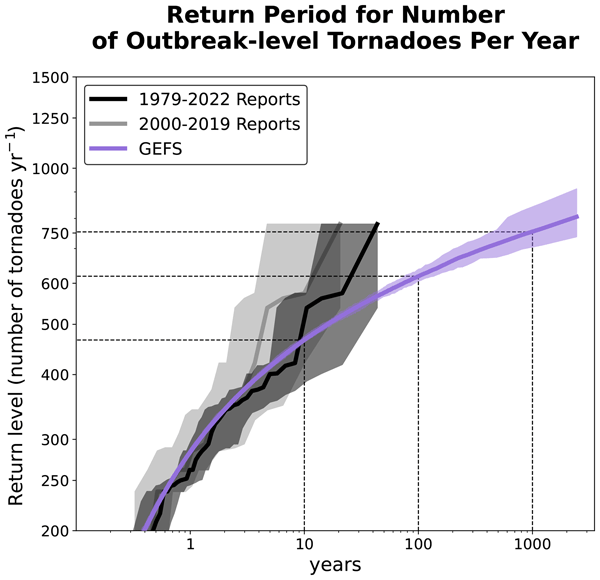
Tornado outbreaks—many tornadoes in short succession—have major impacts, but it is hard to accurately assess their risk because they are rare. We used weather model data to create hundreds of thousands of realistic but unseen tornado outbreak scenarios. With this event set, we estimated U.S. and local outbreak risk and detected clear links to La Niña and upward outbreak activity in recent years.
Timothy DelSole and Michael K. Tippett
Adv. Stat. Clim. Meteorol. Oceanogr., 10, 1–27, https://doi.org/10.5194/ascmo-10-1-2024, https://doi.org/10.5194/ascmo-10-1-2024, 2024
Short summary
Short summary
This paper introduces a method to assess whether two data sets come from the same source. Current methods do not adequately consider spatial and temporal correlations and their annual cycles in a comprehensive test. This method addresses that gap, thereby providing a new and rigorous tool for evaluating the realism of climate simulations and measuring changes in variability over time.
Timothy DelSole and Michael K. Tippett
Adv. Stat. Clim. Meteorol. Oceanogr., 8, 187–203, https://doi.org/10.5194/ascmo-8-187-2022, https://doi.org/10.5194/ascmo-8-187-2022, 2022
Short summary
Short summary
Most climate time series contain annual and diurnal cycles. However, an objective criterion for deciding whether two time series have statistically equivalent annual and diurnal cycles is lacking, particularly if the residual variability is serially correlated. Such a criterion would be helpful in deciding whether a new version of a climate model better simulates such cycles. This paper derives an objective rule for such decisions based on a rigorous statistical framework.
Michael K. Tippett, Chiara Lepore, and Michelle L. L’Heureux
Weather Clim. Dynam., 3, 1063–1075, https://doi.org/10.5194/wcd-3-1063-2022, https://doi.org/10.5194/wcd-3-1063-2022, 2022
Short summary
Short summary
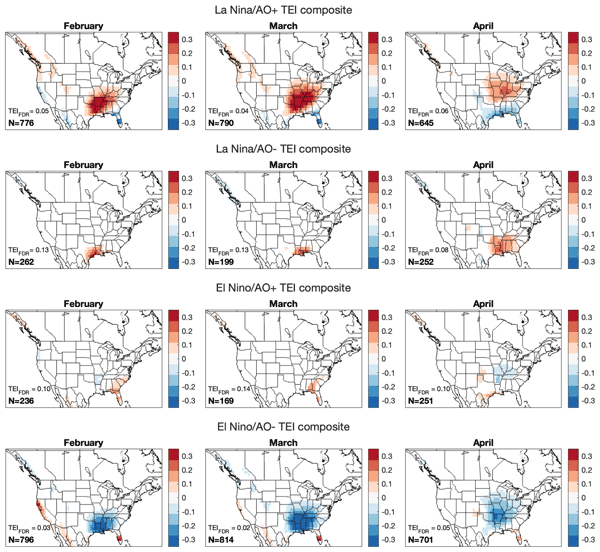
The El Niño–Southern Oscillation (ENSO) and Arctic Oscillation (AO) are phenomena that affect the weather and climate of North America. Although ENSO hails from from the tropical Pacific and the AO high above the North Pole, the spatial patterns of their influence on a North American tornado environment index are remarkably similar in computer models. We find that when ENSO and the AO act in concert, their impact is large, and when they oppose each other, their impact is small.
Timothy DelSole and Michael K. Tippett
Adv. Stat. Clim. Meteorol. Oceanogr., 8, 97–115, https://doi.org/10.5194/ascmo-8-97-2022, https://doi.org/10.5194/ascmo-8-97-2022, 2022
Short summary
Short summary
A common problem in climate studies is to decide whether a climate model is realistic. Such decisions are not straightforward because the time series are serially correlated and multivariate. Part II derived a test for deciding wether a simulation is statistically distinguishable from observations. However, the test itself provides no information about the nature of those differences. This paper develops a systematic and optimal approach to diagnosing differences between stochastic processes.
Timothy DelSole and Michael K. Tippett
Adv. Stat. Clim. Meteorol. Oceanogr., 7, 73–85, https://doi.org/10.5194/ascmo-7-73-2021, https://doi.org/10.5194/ascmo-7-73-2021, 2021
Short summary
Short summary
After a new climate model is constructed, a natural question is whether it generates realistic simulations. Here,
realisticdoes not mean that the detailed patterns on a particular day are correct, but rather that the statistics over many years are realistic. Past approaches to answering this question often neglect correlations in space and time. This paper proposes a method for answering this question that accounts for correlations in space and time.
Cited articles
Anderson, T. W.: An Introduction to Multivariate Statistical Analysis, Wiley-Interscience, ISBN 978-0-471-36091-9, 2003. a
Bartlett, M. S.: Properties of sufficiency and statistical tests, P. Roy. Soc. Lond. Ser. A, 160, 268–282, https://doi.org/10.1098/rspa.1937.0109, 1937. a
Bartlett, M. S.: Multivariate Analysis, Supplement to the Journal of the Royal Statistical Society, 9, 176–197, https://doi.org/10.2307/2984113 1947. a
Brockwell, P. J. and Davis, R. A.: Time Series: Theory and Methods, Springer Verlag, 2nd Edn., ISBN 0-387-97482-2, 1991. a
Chan, D., Kent, E. C., Berry, D. I., and Huybers, P.: Correcting datasets leads to more homogeneous early-twentieth-century sea surface warming, Nature, 571, 393–397, https://doi.org/10.1038/s41586-019-1349-2, 2019. a
DelSole, T.: Software and Data for “Testing Equality of Autoregressive Parameters Without Assuming Equality of Noise Variances”, Zenodo [code and data set], https://doi.org/10.5281/zenodo.17177074, 2025. a
DelSole, T. and Tippett, M. K.: Comparing climate time series – Part 1: Univariate test, Adv. Stat. Clim. Meteorol. Oceanogr., 6, 159–175, https://doi.org/10.5194/ascmo-6-159-2020, 2020. a, b
DelSole, T. and Tippett, M. K.: Comparing climate time series – Part 2: A multivariate test, Adv. Stat. Clim. Meteorol. Oceanogr., 7, 73–85, https://doi.org/10.5194/ascmo-7-73-2021, 2021a. a, b
DelSole, T. and Tippett, M. K.: A mutual information criterion with applications to canonical correlation analysis and graphical models, Stat, 10, e385, https://doi.org/10.1002/sta4.385, 2021b. a
DelSole, T. and Tippett, M. K.: Comparing climate time series – Part 3: Discriminant analysis, Adv. Stat. Clim. Meteorol. Oceanogr., 8, 97–115, https://doi.org/10.5194/ascmo-8-97-2022, 2022a. a, b
DelSole, T. and Tippett, M. K.: Comparing climate time series – Part 4: Annual cycles, Adv. Stat. Clim. Meteorol. Oceanogr., 8, 187–203, https://doi.org/10.5194/ascmo-8-187-2022, 2022b. a, b
DelSole, T. and Tippett, M. K.: Comparison of climate time series – Part 5: Multivariate annual cycles, Adv. Stat. Clim. Meteorol. Oceanogr., 10, 1–27, https://doi.org/10.5194/ascmo-10-1-2024, 2024. a, b
Delworth, T. L., Cooke, W. F., Adcroft, A., Bushuk, M., Chen, J.-H., Dunne, K. A., Ginoux, P., Gudgel, R., Hallberg, R. W., Harris, L., Harrison, M. J., Johnson, N., Kapnick, S. B., Lin, S.-J., Lu, F., Malyshev, S., Milly, P. C., Murakami, H., Naik, V., Pascale, S., Paynter, D., Rosati, A., Schwarzkopf, M. D., Shevliakova, E., Underwood, S., Wittenberg, A. T., Xiang, B., Yang, X., Zeng, F., Zhang, H., Zhang, L., and Zhao, M.: SPEAR: The Next Generation GFDL Modeling System for Seasonal to Multidecadal Prediction and Projection, J. Adv. Model. Earth Sy., 12, e2019MS001895, https://doi.org/10.1029/2019MS001895, 2020. a
Dentener, F. J., Hall, B., and Smith, C.: Annex III: Tables of Historical and Projected Well-mixed Greenhouse Gas Mixing Ratios and Effective Radiative Forcing of All Climate Forcers, in: Climate Change 2021: The Physical Science Basis. Contribution of Working Group I to the Sixth Assessment Report of the Intergovernmental Panel on Climate Change, edited by: Masson-Delmotte, V., Zhai, P., Pirani, A., Connors, S. L., Péan, C., Berger, S., Caud, N., Chen, Y., Goldfarb, L., Gomis, M. I., Huang, M., Leitzell, K., Lonnoy, E., Matthews, J. B. R., Maycock, T. K., Waterfield, T., Yelekci, O., Yu, R., and Zhou, B., chap. Annex III, Cambridge University Press, 2139–2151, 2021. a
Eyring, V., Gleckler, P. J., Heinze, C., Stouffer, R. J., Taylor, K. E., Balaji, V., Guilyardi, E., Joussaume, S., Kindermann, S., Lawrence, B. N., Meehl, G. A., Righi, M., and Williams, D. N.: Towards improved and more routine Earth system model evaluation in CMIP, Earth Syst. Dynam., 7, 813–830, https://doi.org/10.5194/esd-7-813-2016, 2016. a
Grant, A. J. and Quinn, B. G.: Parametric Spectral Discrimination, J. Time Ser. Anal., 38, 838–864, https://doi.org/10.1111/jtsa.12238, 2017. a
Hersbach, H., Bell, B., Berrisford, P., Hirahara, S., Horányi, A., Muñoz-Sabater, J., Nicolas, J., Peubey, C., Radu, R., Schepers, D., Simmons, A., Soci, C., Abdalla, S., Abellan, X., Balsamo, G., Bechtold, P., Biavati, G., Bidlot, J., Bonavita, M., De Chiara, G., Dahlgren, P., Dee, D., Diamantakis, M., Dragani, R., Flemming, J., Forbes, R., Fuentes, M., Geer, A., Haimberger, L., Healy, S., Hogan, R. J., Hólm, E., Janisková, M., Keeley, S., Laloyaux, P., Lopez, P., Lupu, C., Radnoti, G., de Rosnay, P., Rozum, I., Vamborg, F., Villaume, S., and Thépaut, J.-N.: The ERA5 global reanalysis, Q. J. Roy. Meteor. Soc., 146, 1999–2049, https://doi.org/10.1002/qj.3803, 2020. a
Hersbach, H., Bell, B., Berrisford, P., Biavati, G., Horányi, A., Muñoz Sabater, J., Nicolas, J., Peubey, C., Radu, R., Rozum, I., Schepers, D., Simmons, A., Soci, C., Dee, D., and Thépaut, J.-N.: ERA5 monthly averaged data on single levels from 1940 to present, Copernicus Climate Change Service (C3S) Climate Data Store (CDS) [data set], https://doi.org/10.24381/cds.f17050d7, 2023. a
Hogg, R. V., McKean, J. W., and Craig, A. T.: Introduction to Mathematical Statistics, Pearson Education, 8th Edn., ISBN-13 9780137530687, 2019. a
Iturbide, M., Gutiérrez, J. M., Alves, L. M., Bedia, J., Cerezo-Mota, R., Cimadevilla, E., Cofiño, A. S., Di Luca, A., Faria, S. H., Gorodetskaya, I. V., Hauser, M., Herrera, S., Hennessy, K., Hewitt, H. T., Jones, R. G., Krakovska, S., Manzanas, R., Martínez-Castro, D., Narisma, G. T., Nurhati, I. S., Pinto, I., Seneviratne, S. I., van den Hurk, B., and Vera, C. S.: An update of IPCC climate reference regions for subcontinental analysis of climate model data: definition and aggregated datasets, Earth Syst. Sci. Data, 12, 2959–2970, https://doi.org/10.5194/essd-12-2959-2020, 2020a. a, b
Iturbide, M., Gutierrez, J. M., Cimadevilla Alvarez, E., Bedia, J., Hauser, M., and Manzanas, R.: SantanderMetGroup/ATLAS: Final version of “IPCC WGI reference regions v4” (v1.6), Zenodo [code], https://doi.org/10.5281/zenodo.3998463, 2020. a
Lancaster, P.: Explicit Solutions of Linear Matrix Equations, SIAM Rev., 12, 544–566, http://www.jstor.org/stable/2028490 (last access: 19 March 2026), 1970. a
Leith, C. E.: The standard error of time-average estimates of climate means, J. Appl. Meteor., 12, 1066–1069, 1973. a
Lütkepohl, H.: New introduction to multiple time series analysis, Spring-Verlag, https://doi.org/10.1007/978-3-540-27752-1, 2005. a, b, c
Mardia, K. V., Kent, J. T., and Bibby, J. M.: Multivariate Analysis, Academic Press, https://doi.org/10.1002/bimj.4710240520, 1979. a
Newman, M.: An Empirical benchmark for decadal forecasts of global surface temperature anomalies, J. Climate, 26, 5260–5269, 2013. a
Penland, C. and Sardeshmukh, P. D.: The optimal growth of tropical sea-surface temperature anomalies, J. Climate, 8, 1999–2024, 1995. a
Sardeshmukh, P. D. and Penland, C.: Understanding the distinctively skewed and heavy tailed character of atmospheric and oceanic probability distributions, Chaos, 25, 036410, https://doi.org/10.1063/1.4914169, 2015. a
Seber, G. A. F.: A Matrix Handbook for Statisticians, Wiley, ISBN 978-0-471-74869-4, 2008. a
Smith, C., Hall, B., Dentener, F., Ahn, J., Collins, W., Jones, C., Meinshausen, M., Dlugokencky, E., Keeling, R., Krummel, P., Mühle, J., Nicholls, Z., and Simpson, I.: IPCC Working Group 1 (WG1) Sixth Assessment Report (AR6) Annex III Extended Data (v1.0), Zenodo [data set], https://doi.org/10.5281/zenodo.5705391, 2021. a
Download
- Article
(3443 KB) - Full-text XML
Short summary
We derived a new statistical test that can compare climate models and observations more broadly than before, while allowing for both natural fluctuations and human influences. Tests on global temperature data show that most climate models differ from observations in important ways.
We derived a new statistical test that can compare climate models and observations more broadly...