Articles | Volume 3, issue 2
https://doi.org/10.5194/ascmo-3-67-2017
© Author(s) 2017. This work is distributed under
the Creative Commons Attribution 3.0 License.
https://doi.org/10.5194/ascmo-3-67-2017
© Author(s) 2017. This work is distributed under
the Creative Commons Attribution 3.0 License.
14 Jul 2017
Assessing NARCCAP climate model effects using spatial confidence regions
Joshua P. French
CORRESPONDING AUTHOR
Department of Mathematical and Statistical Sciences, University of Colorado Denver, Denver, CO 80204, USA
Seth McGinnis
Institute for Mathematics Applied to Geosciences, National Center for Atmospheric Research, Boulder, CO 80307, USA
Armin Schwartzman
Division of Biostatistics, University of California, San Diego, La Jolla, CA 92093, USA
Related authors
Joshua P. French, Piotr S. Kokoszka, and Seth McGinnis
Adv. Stat. Clim. Meteorol. Oceanogr., 10, 123–141, https://doi.org/10.5194/ascmo-10-123-2024, https://doi.org/10.5194/ascmo-10-123-2024, 2024
Short summary
Short summary
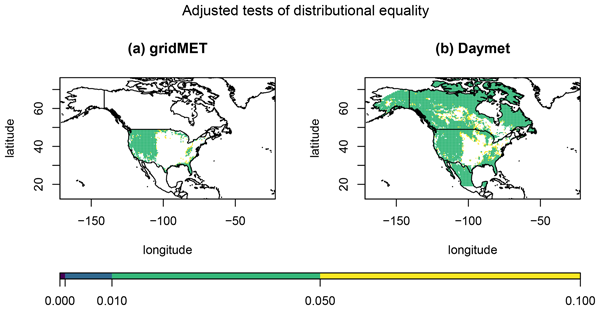
Future climate behavior is typically modeled using computer-based simulations, which are generated for both historical and future time periods. The trustworthiness of these models can be assessed by determining whether the simulated historical climate matches what was observed. We provide a tool that allows researchers to identify major differences between observed climate and climate model predictions, which will hopefully lead to further model refinements.
Jacob Stuivenvolt-Allen, Trude Eidhammer, Rachel McCrary, Melissa Bukovsky, Stefan Rahimi, Hsin-I Chang, and Seth McGinnis
Geosci. Model Dev., 19, 8995–9017, https://doi.org/10.5194/gmd-19-8995-2026, https://doi.org/10.5194/gmd-19-8995-2026, 2026
Short summary
Short summary
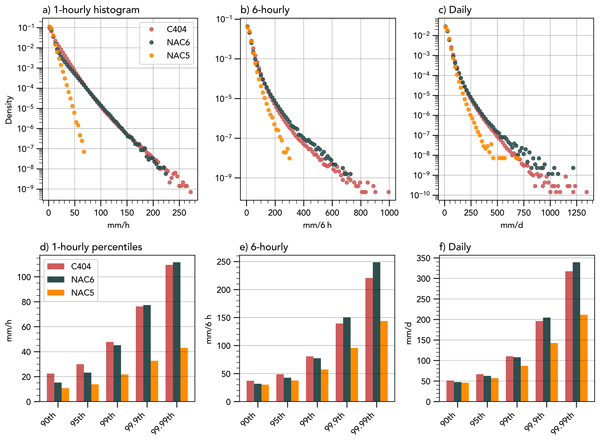
This study presents a new 12 km CORDEX (Coordinated Regional Downscaling Experiment )-CMIP6 (Coupled Model Intercomparison Project) WRF (Weather Research and Forecasting) simulation for North America, compared against an earlier 25 km CMIP5 version and a 4 km convection-permitting simulation. The updated run reduces temperature and precipitation biases, improves precipitation timing, and better captures tropical cyclone intensity. Extreme precipitation at 12 km closely matches convection-permitting results, offering a practical resolution for regional climate assessment.
Kamlesh Sawadekar, Seth McGinnis, Peijun Li, Kathryn Lawson, and Chaopeng Shen
EGUsphere, https://doi.org/10.48550/arXiv.2604.23045, https://doi.org/10.48550/arXiv.2604.23045, 2026
Short summary
Short summary
δCLIMBA can fix consistent errors with global circulation models so their precipitation is locally relevant. Instead of making corrections
directly, it predicts the coefficients of interpretable formulas to minimize bias. δCLIMBA learns to make interpretable corrections that,
once trained, can be easily applied on places without data. It accurately corrects both average rainfall and extreme storm events and
shows the promise to preserve future trends, and generalizes to new regions.
Koichi Sakaguchi, Seth A. McGinnis, L. Ruby Leung, Melissa S. Bukovsky, Rachel R. McCrary, Ziming Chen, Chuan-Chieh Chang, and Yanjie Li
Geosci. Model Dev., 19, 3643–3688, https://doi.org/10.5194/gmd-19-3643-2026, https://doi.org/10.5194/gmd-19-3643-2026, 2026
Short summary
Short summary
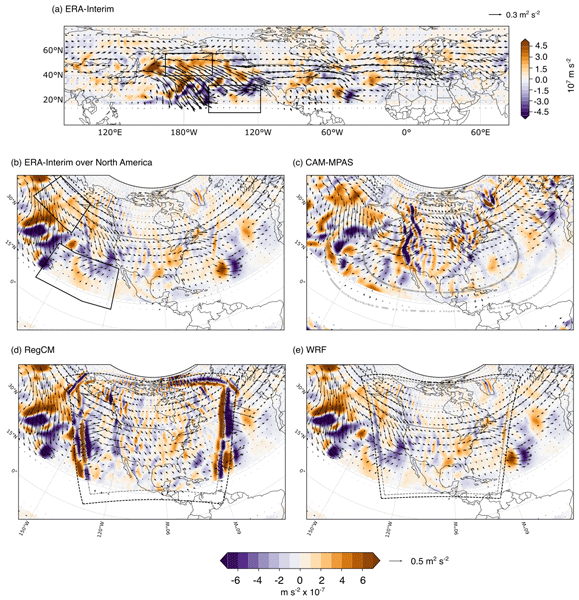
We evaluated Rossby waves in dynamical downscaling simulations over North America, and their connections to surface air temperature variability and heatwaves. Simulated Rossby wave propagation is distorted by flow discontinuities at lateral boundaries and by biased mean wind patterns, thereby breaking the region-specific connections between Rossby waves and surface temperature. Adjusting simulated large-scale winds to match the forcing data can reduce these biases.
Joshua P. French, Piotr S. Kokoszka, and Seth McGinnis
Adv. Stat. Clim. Meteorol. Oceanogr., 10, 123–141, https://doi.org/10.5194/ascmo-10-123-2024, https://doi.org/10.5194/ascmo-10-123-2024, 2024
Short summary
Short summary
Future climate behavior is typically modeled using computer-based simulations, which are generated for both historical and future time periods. The trustworthiness of these models can be assessed by determining whether the simulated historical climate matches what was observed. We provide a tool that allows researchers to identify major differences between observed climate and climate model predictions, which will hopefully lead to further model refinements.
Koichi Sakaguchi, L. Ruby Leung, Colin M. Zarzycki, Jihyeon Jang, Seth McGinnis, Bryce E. Harrop, William C. Skamarock, Andrew Gettelman, Chun Zhao, William J. Gutowski, Stephen Leak, and Linda Mearns
Geosci. Model Dev., 16, 3029–3081, https://doi.org/10.5194/gmd-16-3029-2023, https://doi.org/10.5194/gmd-16-3029-2023, 2023
Short summary
Short summary
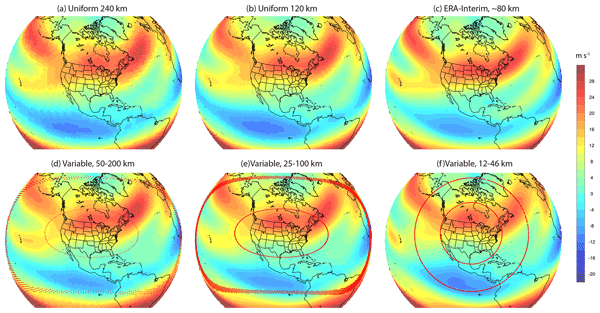
We document details of the regional climate downscaling dataset produced by a global variable-resolution model. The experiment is unique in that it follows a standard protocol designed for coordinated experiments of regional models. We found negligible influence of post-processing on statistical analysis, importance of simulation quality outside of the target region, and computational challenges that our model code faced due to rapidly changing super computer systems.
Cited articles
Akaike, H.: A new look at the statistical model identification, IEEE T. Automat. Contr., 19, 716–723, https://doi.org/10.1109/TAC.1974.1100705, 1974.
Arnold, J. B.: ggthemes: Extra Themes, Scales and Geoms for “ggplot2”, available at: https://CRAN.R-project.org/package=ggthemes (last access: 5 May 2017), R package version 3.0.3, 2016.
Benjamini, Y. and Heller, R.: False Discovery Rates for Spatial Signals, J. Am. Stat. Assoc., 102, 1272–1281, https://doi.org/10.1198/016214507000000941, 2007.
Benjamini, Y. and Hochberg, Y.: Controlling the False Discovery Rate: A Practical and Powerful Approach to Multiple Testing, J. Roy. Stat. Soc. B, 57, 289–300, 1995.
Bolin, D. and Lindgren, F.: Excursion and contour uncertainty regions for latent Gaussian models, J. Roy. Stat. Soc. B, 77, 85–106, https://doi.org/10.1111/rssb.12055, 2015.
Brownrigg, R., Minka, T. P., and Deckmyn, A.: maps: Draw Geographical Maps, available at: https://CRAN.R-project.org/package=maps (last access: 10 July 2017), R package version 3.1.0, 2016.
Caya, D. and Laprise, R.: A semi-implicit semi-Lagrangian regional climate model: The Canadian RCM, Mon. Weather Rev., 127, 341–362, https://doi.org/10.1175/1520-0493(1999)127<0341:ASISLR>2.0.CO;2, 1999.
Collins, M., Booth, B. B., Harris, G. R., Murphy, J. M., Sexton, D. M., and Webb, M. J.: Towards quantifying uncertainty in transient climate change, Clim. Dynam., 27, 127–147, https://doi.org/10.1007/s00382-006-0121-0, 2006.
Dahl, D. B.: xtable: Export Tables to LaTeX or HTML, available at: https://CRAN.R-project.org/package=xtable (last access: 5 May 2017), R package version 1.8-2, 2016.
Deser, C., Phillips, A., Bourdette, V., and Teng, H.: Uncertainty in climate change projections: the role of internal variability, Clim. Dynam., 38, 527–546, https://doi.org/10.1007/s00382-010-0977-x, 2012.
Dowle, M., Srinivasan, A., Short, T., and Lianoglou, S.: data.table: Extension of Data.frame, available at: https://CRAN.R-project.org/package=data.table (last access: 5 May 2017), R package version 1.9.6, 2015.
Flato, G. et al.: The Canadian centre for climate modeling and analysis global coupled model and its climate, Clim. Dynam., 16, 451–467, https://doi.org/10.1007/s003820050339, 2000.
French, J.: SpatialTools: Tools for Spatial Data Analysis, available at: http://CRAN.R-project.org/package=spatialtools (last access: 5 May 2017), R package version 1.0.2, 2015.
French, J.: autoimage: Display Multiple Images with Scaled Colors, R package version 1.3, 2017.
French, J. P.: Confidence regions for the level curves of spatial data, Environmetrics, 25, 498–512, https://doi.org/10.1002/env.2295, 2014.
French, J. P. and Hoeting, J. A.: Credible regions for exceedance sets of geostatistical data, Environmetrics, 27, 4–14, https://doi.org/10.1002/env.2371, 2016.
French, J. P. and Sain, S. R.: Spatio-temporal exceedance locations and confidence regions, Ann. Appl. Stat., 7, 1421–1449, https://doi.org/10.1214/13-AOAS631, 2013.
Genz, A., Bretz, F., Miwa, T., Mi, X., Leisch, F., Scheipl, F., and Hothorn, T.: mvtnorm: Multivariate Normal and t Distributions, available at: http://CRAN.R-project.org/package=mvtnorm (last access: 5 May 2017), R package version 1.0-6, 2017.
GFDL GAMDT (The GFDL Global Atmospheric Model Development Team): The new GFDL global atmospheric and land model AM2-LM2: Evaluation with prescribed SST simulations, J. Climate, 17, 4641–4673, https://doi.org/10.1175/JCLI-3223.1, 2004.
Giorgi, F., Marinucci, M. R., and Bates, G. T.: Development of a second-generation regional climate model (RegCM2). Part I: Boundary-layer and radiative transfer processes, Mon. Weather Rev., 121, 2794–2813, https://doi.org/10.1175/1520-0493(1993)121<2814:DOASGR>2.0.CO;2, 1993a.
Giorgi, F., Marinucci, M. R., Bates, G. T., and De Canio, G.: Development of a second-generation regional climate model (RegCM2). Part II: Convective processes and assimilation of lateral boundary conditions, Mon. Weather Rev., 121, 2814–2832, https://doi.org/10.1175/1520-0493(1993)121<2794:DOASGR>2.0.CO;2, 1993b.
Gordon, C., Cooper, C., Senior, C. A., Banks, H., Gregory, J. M., Johns, T. C., Mitchell, J. F., and Wood, R. A.: The simulation of SST, sea ice extents and ocean heat transports in a version of the Hadley Centre coupled model without flux adjustments, Clim. Dynam., 16, 147–168, https://doi.org/10.1007/s003820050010, 2000.
Grell, G., Dudhia, J., and Stauffer, D.: A description of the fifth generation Penn State/NCAR Mesoscale Model (MM5), 107 pp., Tech. rep., National Center for Atmospheric Research, NCAR Technical Note NCAR/TN-398, 1993.
Gu, H., Zong, Z., and Hung, K.: A modified superconvergent patch recovery method and its application to large deformation problems, Finite Elem. Anal. Des., 40, 665–687, https://doi.org/10.1016/S0168-874X(03)00109-4, 2004.
Hankin, R. K. S.: Recreational mathematics with R: introducing the “magic” package., R News, 5, 2005.
Hill, C., DeLuca, C., Balaji, Suarez, M., and Silva, A. D.: The architecture of the Earth System Modeling Framework, Comput. Sci. Eng., 6, 18–28, https://doi.org/10.1109/MCISE.2004.1255817, 2004.
Holm, S.: A simple sequentially rejective multiple test procedure, Scand. J. Stat., 6, 65–70, 1979.
Hyndman, R. J. and Athanasopoulos, G.: Forecasting: principles and practice, OTexts: Melbourne, Australia, available at: https://www.otexts.org/fpp/2/6 (last access: 22 July 2016), 2013.
IPCC: Emissions Scenarios, Cambridge University Press, Cambridge, 2000.
Jones, R., Noguer, M., Hassell, D., Hudson, D., Wilson, S., Jenkins, G., and Mitchell, J.: Generating high resolution climate change scenarios using PRECIS, Met Office Hadley Centre, Exeter, 2004.
Juang, H.-M. H., Hong, S.-Y., and Kanamitsu, M.: The NCEP regional spectral model: an update, B. Am. Meteorol. Soc., 78, 2125–2143, https://doi.org/10.1175/1520-0477(1997)078<2125:TNRSMA>2.0.CO;2, 1997.
Kaufman, C. G. and Sain, S. R.: Bayesian functional ANOVA modeling using Gaussian process prior distributions, Bayesian Anal., 5, 123–149, https://doi.org/10.1214/10-BA505, 2010.
Khoei, A. and Gharehbaghi, S.: The superconvergence patch recovery technique and data transfer operators in 3D plasticity problems, Finite Eleme. Anal. Des., 43, 630–648, https://doi.org/10.1016/j.finel.2007.01.002, 2007.
Klaus, B. and Strimmer, K.: fdrtool: Estimation of (Local) False Discovery Rates and Higher Criticism, available at: https://CRAN.R-project.org/package=fdrtool (last access: 5 May 2017), R package version 1.2.15, 2015.
Ljung, G. and Box, G.: On a measure of lack of fit in time series models, Biometrika, 65, 297–303, https://doi.org/10.1093/biomet/65.2.297, 1978.
Maurer, E. P., Brekke, L., Pruitt, T., and Duffy, P. B.: Fine resolution climate projections enhance regional climate change impact studies, EOS, Transactions American Geophysical Union, 88, 504–504, https://doi.org/10.1371/journal.pone.0071297, 2007.
McGinnis, S., Nychka, D., and Mearns, L. O.: A new distribution mapping technique for climate model bias correction, in: Machine Learning and Data Mining Approaches to Climate Science, Springer International Publishing, 91–99, 2015.
Mearns, L. O., Gutowski, W., Jones, R., Leung, R., McGinnis, S., Nunes, A., and Qian, Y.: A regional climate change assessment program for North America, EOS, Transactions American Geophysical Union, 90, 311–311, https://doi.org/10.1029/2009EO360002, 2009.
Mearns, L. O., Arritt, R., Biner, S., Bukovsky, M. S., McGinnis, S., Sain, S., Caya, D., Correia, J., Flory, D., Gutowski, W., Takle, E. S., Jones, R., Leung, R., Moufouma-Okia, W., McDaniel, L., Nunes, A. M., Qian, Y., Roads, J., Sloan, L., and Snyder, M.: The North American regional climate change assessment program: overview of phase I results, B. Am. Meteorol. Soc., 93, 1337–1362, https://doi.org/10.1175/BAMS-D-11-00223.1, 2012.
Meehl, G. A., Stocker, T. F., Collins, W. D., Friedlingstein, P., Gaye, A. T., Gregory, J. M., Kitoh, A., Knutti, R., Murphy, J. M., Noda, A., Raper, S. C. B., Watterson, I. G., Weaver, A. J., and Zhao, Z.-C.: Global climate projections, in Climate Change 2007: The Physical Science Basis—Contribution of Working Group 1 to the Fourth Assessment Report of the Intergovernmental Panel on Climate Change, chap. 10, Cambridge University Press, New York, 747–843, 2007.
Murdoch, D. J., Tsai, Y.-L., and Adcock, J.: P-Values are Random Variables, Am. Stat., 62, 242–245, https://doi.org/10.1198/000313008X332421, 2008.
National Center for Atmospheric Research: Regridding using NCL with Earth System Modeling Framework (ESMF) software, available at: http://www.ncl.ucar.edu/Applications/ESMF.shtml, last access: 22 March 2017.
Neuwirth, E.: RColorBrewer: ColorBrewer Palettes, available at: https://CRAN.R-project.org/package=RColorBrewer (last access: 5 May 2017), R package version 1.1-2, 2014.
Nychka, D., Furrer, R., Paige, J., and Sain, S.: fields: Tools for Spatial Data, available at: https://CRAN.R-project.org/package=fields (last access: 5 May 2017), https://doi.org/10.5065/D6W957CT, R package version 8.3-6, 2016.
Pinheiro, J., Bates, D., DebRoy, S., Sarkar, D., and R Core Team: nlme: Linear and Nonlinear Mixed Effects Models, available at: http://CRAN.R-project.org/package=nlme (last access: 5 May 2017), R package version 3.1-131, 2017.
Plate, T. and Heiberger, R.: abind: Combine Multidimensional Arrays, available at: https://CRAN.R-project.org/package=abind (last access: 10 July 2017), R package version 1.4-5, 2016.
Pope, V., Gallani, M., Rowntree, P., and Stratton, R.: The impact of new physical parametrizations in the Hadley Centre climate model: HadAM3, Clim. Dynam., 16, 123–146, https://doi.org/10.1007/s003820050009, 2000.
R Core Team: R: A Language and Environment for Statistical Computing, R Foundation for Statistical Computing, Vienna, Austria, available at: https://www.R-project.org/ (last access: 5 May 2017), 2016.
Sain, S. R., Nychka, D., and Mearns, L.: Functional ANOVA and regional climate experiments: a statistical analysis of dynamic downscaling, Environmetrics, 22, 700–711, https://doi.org/10.1002/env.1068, 2011.
Scinocca, J. and McFarlane, N.: The variability of modeled tropical precipitation, J. Atmos. Sci., 61, 1993–2015, https://doi.org/10.1175/1520-0469(2004)061<1993:TVOMTP>2.0.CO;2, 2004.
Shen, X., Huang, H.-C., and Cressie, N.: Nonparametric hypothesis testing for a spatial signal, J. Am. Stat. Assoc., 97, 1122–1140, 2002.
Skamarock, W. C., Klemp, J. B., Dudhia, J., Gill, D. O., Barker, D. M., Wang, W., and Powers, J. G.: A description of the advanced research WRF version 2, Tech. rep., National Center for Atmospheric Research, NCAR Technical Note NCAR/TN-468+STR, 2005.
Sommerfeld, M. and French, J. P.: cope: Coverage Probability Excursion (CoPE) Sets, R package version 0.2.3, 2017.
Sommerfeld, M., Sain, S., and Schwartzman, A.: Confidence regions for excursion sets in asymptotically Gaussian random fields, with an application to climate, arXiv preprint arXiv:1501.07000, 2015.
Storey, J. D. and Tibshirani, R.: Statistical significance for genome-wide experiments, P. Natl. Acad. Sci. USA, 100, 9440–9445, https://doi.org/10.1073/pnas.1530509100, 2003.
Sun, W., Reich, B. J., Tony Cai, T., Guindani, M., and Schwartzman, A.: False discovery control in large-scale spatial multiple testing, J. Roy. Stat. Soc. B, 77, 59–83, https://doi.org/10.1111/rssb.12064, 2015.
Teutschbein, C. and Seibert, J.: Bias correction of regional climate model simulations for hydrological climate-change impact studies: Review and evaluation of different methods, J. Hydrol., 456–457, 12–29, https://doi.org/10.1016/j.jhydrol.2012.05.052, 2012.
Venables, W. N. and Ripley, B. D.: Modern Applied Statistics with S, Springer, New York, 4th Edn., available at: http://www.stats.ox.ac.uk/pub/MASS4 (last access: 10 July 2017), iSBN 0-387-95457-0, 2002.
Weisberg, S.: Applied Linear Regression, 4th Edn., Wiley, Hoboken, 2014.
Wickham, H.: ggplot2: Elegant Graphics for Data Analysis, Springer-Verlag New York, available at: http://ggplot2.org (last access: 10 July 2017), 2009.
Wilks, D. S.: Statistical Methods in the Atmospheric Sciences, vol. 100, Academic Press, 2011.
Short summary
We assess the mean temperature effect of global and regional climate model combinations for the North American Regional Climate Change Assessment Program using varying classes of linear regression models, including possible interaction effects. We use both pointwise and simultaneous inference procedures to identify regions where global and regional climate model effects differ. We conclusively show that accounting for multiple comparisons is important for making proper inference.
We assess the mean temperature effect of global and regional climate model combinations for the...


